What Is a Futures Wheel?
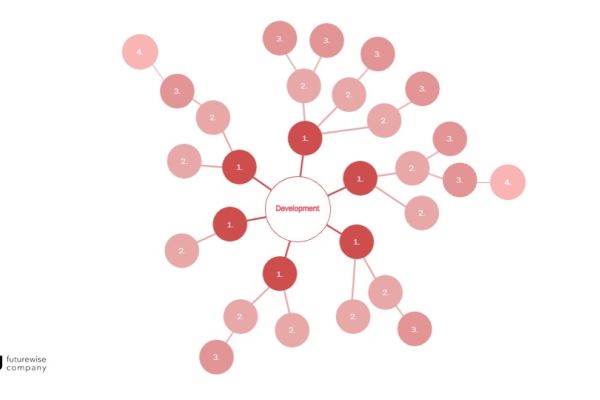
A simple tool to think complex thoughts about the future
The Futures Wheel is one of those rare foresight tools that looks deceptively simple — and then quietly forces you to confront how non-linear the future really is.
Originally developed in 1971 by Jerome C. Glenn, the Futures Wheel has guided futurists, strategists, and decision-makers for more than five decades in exploring the ripple effects of change. It is also documented in the Futures Research Methodology (FRM), one of the core reference works in professional foresight.
At its core, the Futures Wheel helps individuals and organizations move beyond linear cause-and-effect thinking, and instead map how one change can cascade across systems, sectors, and societies.
The basic idea
A Futures Wheel is a structured, visual brainstorming method used in strategic foresight to explore the direct and indirect consequences of a specific trend, event, decision, or innovation.
It asks:
“And then what?”
“And what follows from that?”
“Who else is affected, and how?”
The result looks a bit like a spider web or a set of concentric circles — but conceptually, it represents chains of impact spreading outward over time.
How a Futures Wheel is structured
The structure is deliberately simple:
1. The center: the change
At the core sits a single, clearly defined change, often phrased as a thesis:
- A new technology
- A regulatory shift
- A strategic decision
- A societal or economic trend
Example: “Autonomous trucks become mainstream in Europe.”
2. First-order consequences
In the first ring around the center, you map direct, immediate effects — the things that happen because the change occurs.
These are often the most obvious impacts.
3. Second- and third-order consequences
From each first-order consequence, you then ask: “What does this lead to?”
These indirect effects populate the outer rings:
- Effects of effects
- Side effects
- Feedback loops
- Unintended consequences
What problem does the Futures Wheel solve?
Most strategic thinking fails in one of two ways:
- It stays too linear (“If X happens, Y follows”).
- It focuses only on first-order effects, missing the real strategic implications.
The Futures Wheel is designed to do the opposite. Its purpose is to:
- Surface complex, interconnected consequences
- Reveal unexpected risks and opportunities
- Challenge optimistic or pessimistic single-story futures
- Make implicit assumptions visible
In short: it helps teams think systemically about change.
Where and how it is used
The Futures Wheel is widely applied across contexts, including:
- Strategy & innovation: exploring second-order effects of new products or business models
- Technology foresight: assessing societal, economic, and regulatory impacts of emerging tech
- Policy & regulation: anticipating unintended consequences of laws or reforms
- Organizational decision-making: stress-testing major strategic moves
It is especially useful early in a foresight or strategy process, before numbers, roadmaps, or KPIs narrow the field of vision.