


Remember the spring of 2020? For about six months, you couldn’t open a newspaper, a LinkedIn feed, or a quarterly earnings call without somebody, somewhere, calling the pandemic a „black swan event.“ Politicians used it to suggest that no reasonable government could have been expected to prepare for the thing that had, in fact, been war-gamed repeatedly by public health agencies for over a decade.
The phrase did a lot of work in those months, most of it apologetic. A black swan, in the way the term was thrown around, was something nobody could have seen coming, which conveniently meant that nobody could really be blamed for failing to see it coming. The trouble is that Nassim Nicholas Taleb, who popularized the idea, was almost immediately on television and in op-eds explaining that COVID-19 was not a black swan at all. Pandemics had been forecast. The warning signs were on the record. What was actually surprising wasn’t the event but the discovery, in real time, of how fragile the supply chains, the hospitals, and the political institutions turned out to be when the predictable thing finally happened.
That whole episode is a useful way into a much older idea from the world of strategic foresight, one that predates Taleb by a decade and a half and that, in some ways, captures what we were trying to describe more precisely than the black swan ever did. The idea is called the wild card.
A wild card is a future event with a low probability of occurring and a very high impact if it does. The definition sounds clinical, and it is, but the concept itself is older than most people realize. It was formalized in 1992 by the Copenhagen Institute for Futures Studies, working with BIPE Conseil and the Institute for the Future, and it entered wider circulation in 1997 through John L. Petersen’s book Out of the Blue – Wild Cards and Other Big Future Surprises. Petersen wasn’t claiming to predict the future. He was making a more interesting argument: that any serious planner had a professional obligation to spend at least some time staring at the unlikely corners of the distribution, rather than the comfortable middle where most strategy gets written.
Black swans and wild cards are close relatives. Wild cards live in the working vocabulary of foresight practitioners, who deliberately surface them in scenario exercises, stress tests, and strategy retreats; they are things you put on a whiteboard and argue about. Black swans, in Taleb’s stricter sense, are events that were essentially invisible beforehand and only look inevitable in retrospect.
What sits between them, and what foresight people spend most of their time worrying about, is the question of weak signals. Wild cards rarely arrive in complete silence. They tend to be preceded by fragments of information that look like noise at the time and only become meaningful in hindsight: an oddly worded paper in an obscure journal, a procurement contract in a country nobody is paying attention to, a small shift in the language used by a regulator, a cluster of unusual hospital admissions in a town that doesn’t normally make the news. The hard part is organizational: Most reporting structures inside companies and governments are designed to filter exactly this kind of signal out as irrelevant, because most of the time it is. The discipline of foresight is largely the discipline of building institutions that can hold onto the weird stuff a little longer than instinct suggests they should.
The Four Animals in the Foresight Bestiary
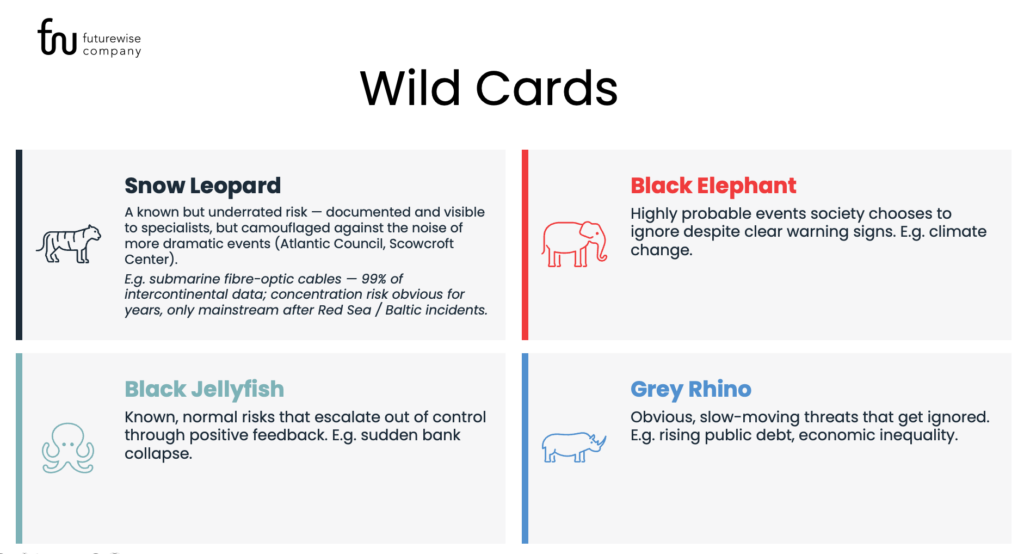
Snow Leopard
A known but underrated phenomenon: documented and visible to specialists, but camouflaged against the noise of more dramatic events and therefore systematically underweighted. The metaphor was developed by the Atlantic Council’s Scowcroft Center for its Global Foresight reports, named for the species‘ disruptive coat pattern that breaks up its outline against Himalayan terrain — the ghost of the mountains. (Some risk-management writers use white leopard for the same idea.)
Example: the vulnerability of submarine fibre-optic cables, which carry roughly 99 percent of intercontinental data and a significant share of global financial settlements. The concentration risk has been documented for years; it took incidents in the Red Sea, the Baltic, and the Taiwan Strait to bring it into mainstream view.
Black Elephant
A high-probability, high-impact event that is already documented and discussed by specialists, but that society chooses to treat as unlikely because acknowledging it would demand uncomfortable change. The term was coined in 2009 by disaster-relief consultant Vinay Gupta and popularized in 2014 by environmentalist Adam Sweidan through Thomas Friedman’s New York Times column. When the elephant finally arrives, it gets relabelled a black swan that nobody could have seen coming.
Example: anthropogenic climate change. The physics has been understood since Arrhenius’s 1896 calculations, the projection literature is consistent across IPCC cycles, and the response has nevertheless behaved as though the problem belongs to a future generation.
Black Jellyfish
A known, ostensibly normal phenomenon that escalates into systemic crisis through positive feedback — a small input that, amplified by interconnected systems, produces effects out of all proportion to its starting scale. The term comes from Ziauddin Sardar’s postnormal times theory and represents „unknown knowns“: phenomena we believe we understand but whose behaviour at scale surprises us.
Example: the 2013 shutdown of Sweden’s Oskarshamn nuclear plant, when Aurelia aurita blooms — driven by warming seas, ocean acidification, and overfishing of jellyfish predators — clogged the cooling intakes and forced a 1,400-megawatt reactor offline.
Grey Rhino
A high-probability, high-impact threat that is large, visible, slow-moving, and consistently ignored despite a complete absence of any information deficit. Introduced by policy analyst Michele Wucker in her 2013 World Economic Forum address and developed in her 2016 book The Gray Rhino. Wucker’s point, against the prevailing fashion for black swan vocabulary, is that most major crises are not surprises at all; the interesting question is why the institutions in their path failed to move.
Example: the 2008 subprime crisis. Shiller’s Irrational Exuberance documented the housing bubble in 2005, the Bank for International Settlements flagged systemic risk in 2006 and 2007, and the FBI warned of a mortgage-fraud „epidemic“ as early as 2004. The rhino was visible from a considerable distance.
The point of wild card thinking isn’t prediction; it’s the cultivation of adaptive capacity, in the same sense biologists and resilience engineers use the term. An organization that has seriously rehearsed the loss of its largest supplier tends to handle the loss of its second-largest one with more composure, even though the specific scenario was wrong, because the underlying flexibility transfers. Beyond that, sitting with the improbable for any length of time tends to bring back into the strategy conversation a set of unfashionable virtues — redundancy, optionality, slack, balance sheet conservatism — that long periods of stability quietly erode, and whose absence is universally regretted in the first quarter after stability ends.
So what does all of this leave us with, after the dust of the past few years has settled and „black swan“ has gone the way of most overused phrases? Mostly a sharper vocabulary, and a slightly more honest one. The wild cards, the elephants, the jellyfish, the leopards, the rhinos — these aren’t predictions and were never meant to be. They are a way of naming the different ways the future tends to escape the assumptions we’ve built our planning on, and a reminder that when the next big surprise lands, the interesting question won’t be whether it was foreseeable. It almost always was, by somebody. The interesting question will be whether anyone in the room had been paying attention.