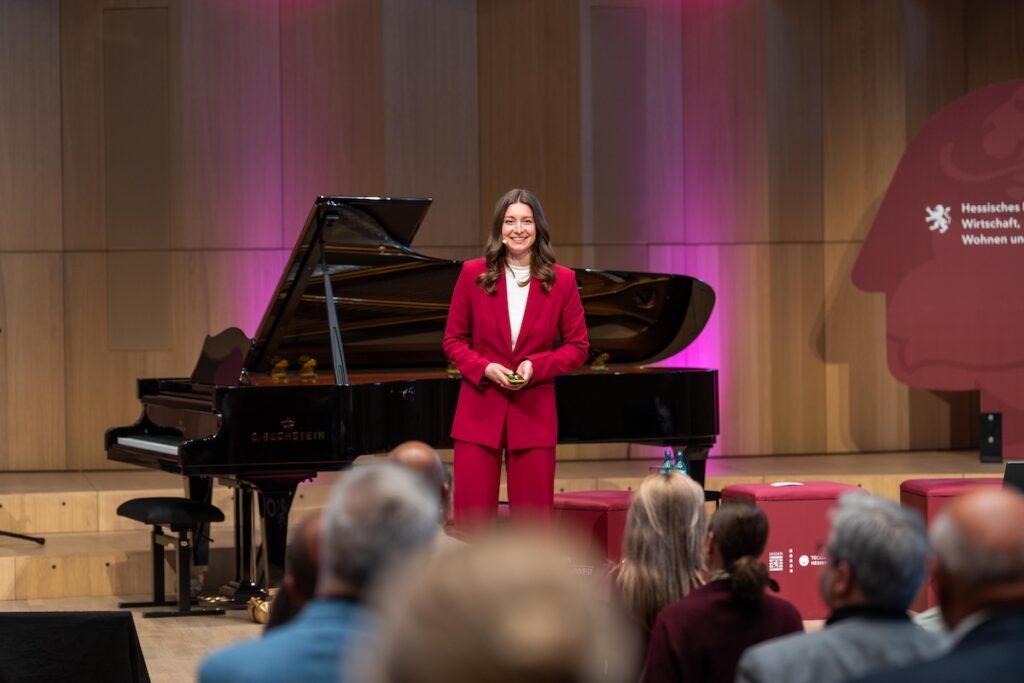
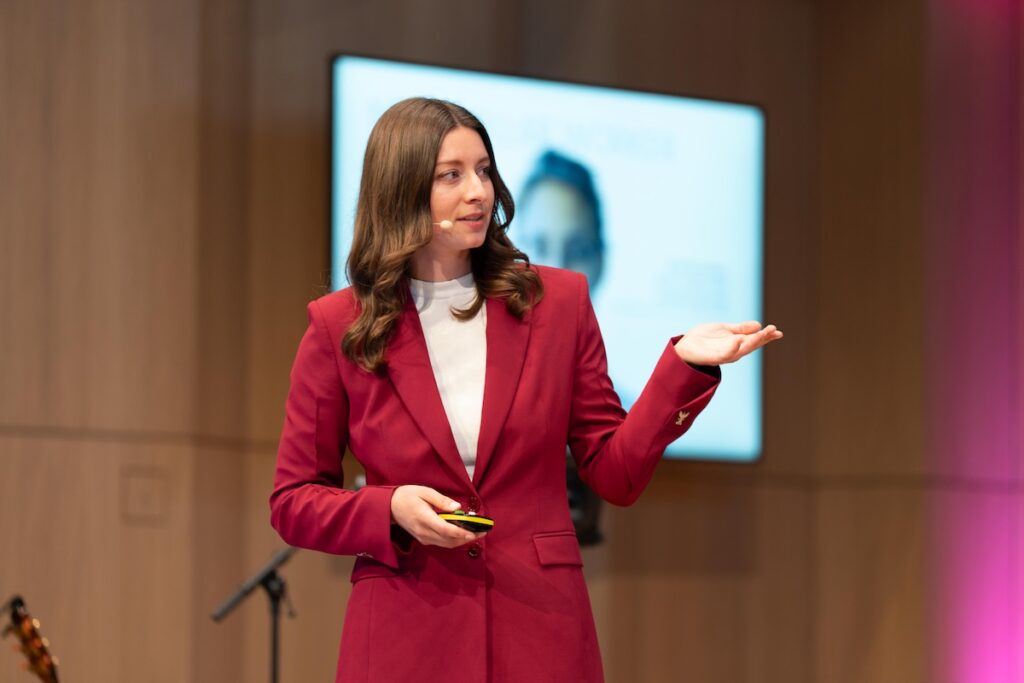
Carina Stöttner at the LEON Congress Hesse: in conversation with Hesse’s Deputy Minister-President, generals, and CEOs
Photo: Jana Kay. From left: Brigadier General Holger Radmann, Prof. Dr.-Ing. Guido H. Baltes (moderator), Christoph Bernius (Divisional Board Member Cyber Risk, Commerzbank AG), Kaweh Mansoori (Minister of Economic Affairs), Carina Stöttner (CEO Futurewise Company), Alexander Laukenmann (Senior Executive VP Fraport), Peter R. Manolopoulos (CEO Schunk Group).A look back at the closing keynote by futures researcher Carina Stöttner at LEON 2026 – and what she had to say about the future of industrial work, resilience, and the risks of overcorrected protectionism.
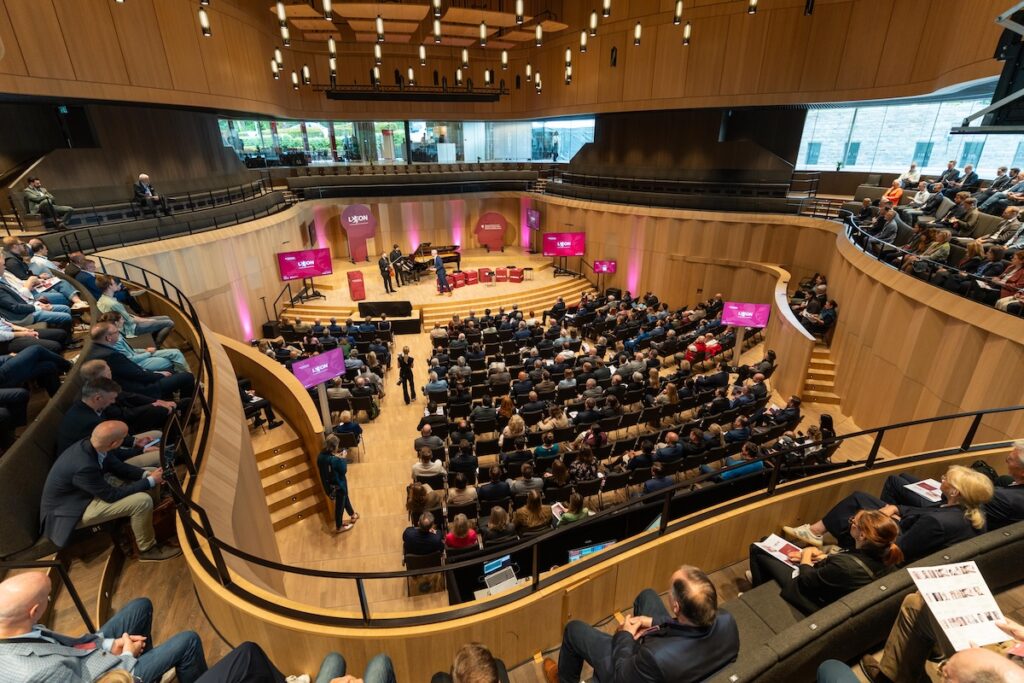
It is already past 5 p.m. at the Casals Forum in Kronberg. A long day of the congress lies behind the roughly one hundred decision-makers from business, science, politics, and the German armed forces. The day’s major themes – resilience, security, transformation financing, the Mittelstand as an anchor of stability – have been drawn out. Introduced by Prof. Dr.-Ing. Guido H. Baltes, Carina Stöttner takes the stage and poses the question: where could German industry and the economy develop in the future?
Stöttner is a futures researcher – not a forecaster who extends charts into the next ten years, but someone who works with companies, ministries, and educational institutions to make desired futures concrete. Her closing keynote “The Future of Industrial Work” was not a full stop, but a starting signal: for a debate that has been conducted too technocratically in Germany for too long – and now needs a direction.
Resilience is not defense – but the ability to build the future
Throughout the day, resilience had been the leitmotif of LEON 2026. Minister of Economic Affairs Kaweh Mansoori had declared it the “decisive prerequisite for competitiveness.” Stöttner picked up the term – and turned it around.
Resilience, as the thrust of her keynote went, is not the attempt to defend a status quo against an uncertain world. Resilience is the ability to remain capable of action despite – and with the help of – disruptive change, and to shape desirable futures. Those who understand resilience merely as a protective shield build bunkers. Those who understand it as the capacity to shape things build platforms.
This set the frame for the keynote’s two major thematic strands: deeptech and radical innovation on the one side, education and the work of the future on the other.
Deeptech and radical innovation: Germany’s real question of competitiveness as a location
Germany has an innovation paradox. Strong in research, strong in patents, strong in its Mittelstand – and yet behind the USA and China in many key technologies. Stöttner delivered a diagnosis for this that resonated in the room: We have perfected incremental innovation, but have structurally weaned ourselves off radical innovation.
Deeptech – that is, technologies with high scientific risk and a long development horizon, from quantum computing through synthetic biology to new energy and materials systems – requires different conditions than the optimizing innovation in which German industry grew large:
Longer capital horizons than the typical German financing mix offers today
A higher tolerance for failure, both within companies and in the logic of public funding
Closer interlocking of cutting-edge research and industrial scaling, as well as international cooperation
Talent that thinks across disciplines and can move between lab, code, and factory floor
Fotografie KimFotografie KimFotografie KimFotografie Kim
The trade-offs of protectionism: When resilience becomes a cage
Stöttner devoted perhaps the most delicate part of her keynote to a question that is often circumvented in the current industrial-policy discourse: What happens when protectionism becomes too drastic?
Resilience and sovereignty are legitimate, even compelling, goals. But they have a downside that must be named in honest industrial policy:
Loss of innovation through isolation. Those who reorganize critical intermediate products on a purely national basis pay not only higher unit costs, but also lose the competitive pressure and knowledge exchange that drives innovation. Closed systems age faster than open ones.
Strategic costs of the subsidy spiral. Every industry kept in the country by subsidy ties up resources that are then lacking elsewhere. Where investment goes into the production of efficient commodities, capacities no longer suffice for new high technologies. Industrial policy is always also an allocation decision against alternative futures.
Reciprocity risks. Protective measures provoke protective measures. An exporting nation like Germany loses structurally more in an escalating protectionism spiral – in social prosperity and in growth.
Democratic erosion. When “strategic industries” become a permanent category, the entanglements between the state and corporations grow, weakening competition and renewal in the long term.
Stöttner’s plea was not a naive call for free trade, but a plea for measure: resilience where it is relevant to security and not otherwise attainable – and openness everywhere else, because openness remains the true source of innovation and prosperity. The desirable future lies not in maximal self-sufficiency, but in smart, partnership-based sovereignty.
What remains: Three imperatives for the next decade
From Stöttner’s keynote, three imperatives can be distilled that apply to any industrial and economic location – and to Hesse in particular:
Bet on deeptech and radical innovation. Incremental improvement is a mandatory exercise, no longer a competitive advantage. The real challenge is: financing, organizing, and scaling technologies with a ten- to fifteen-year horizon now.
Think about education and work from the perspective of the life course. Not curricula, but learning architectures. Not qualification as a project, but learning as infrastructure.
Balance resilience and openness. Sovereignty where it is indispensable. Openness everywhere else – as a source of innovation, talent, and economic strength.
About the congress: LEON 2026 in Kronberg, Hesse
On 6 May 2026, representatives from business, science, politics, and security institutions came together at the Casals Forum Wiesbaden for the new Hessian economic and industrial congress LEON. The leitmotif: resilience as the decisive question of competitiveness for the 21st century.
Three brackets held the day together:
Resilience becomes a question of competitiveness – in the face of fragile supply chains, geopolitical tensions, and rising energy and security requirements.
Industry, innovation, and security can no longer be thought of separately. Key technologies such as AI or new materials have civilian and security-relevant applications.
From a problem of insight to a problem of implementation. “We do not have a problem of insight, but rather a task of implementation,” Minister of Economic Affairs Kaweh Mansoori put it in his opening remarks.
The keynotes and impulses at a glance
Kaweh Mansoori, Hessian Minister of Economic Affairs – Opening
Prof. Marcel Fratzscher (DIW Berlin) – Keynote: “After Us, the Future. A New Generational Contract for Freedom, Security, and Opportunity”
Peter R. Manolopoulos (CEO Schunk Group) – “What Makes Us Strong: Resilience in the Industrial Mittelstand”
Hans-Dieter Kemler (Member of the Board, Helaba) – “Transformation Financing in Germany – Hesse Leads the Way”
Alexander Laukenmann (Senior Executive VP Fraport) stepped in forDr. Pierre Dominique Prümm (Member of the Board, Aviation, Fraport AG) – “Rethinking Resilience: How Aviation Shapes the Future in Turbulent Times”
Christoph Bernius (Divisional Board Member Cyber Risk, Commerzbank AG) – “Cyber Resilience: Europe’s Path to Security and Economic Strength”
Dr. Kai Beckmann (CEO Merck KGaA) – Video message on the future of Merck
Defence Panel with Major General Wolf-Jürgen Stahl (President, BAKS), Thomas Mailänder (EDAG), Daniel Zittel (Daimler Truck), Prof. Dr. Andreas Glas (UniBw Munich), Dr. Hans Christoph Atzpodien (BDSV), and Brigadier General Holger Radmann (Landeskommando Hesse): “Why We Need Strong Cooperation Between the Bundeswehr, Business, and Innovation”
Nathalia Schomerus (Legal Innovation Lead, Legora) – “Security and Resilience of German Industry with Regard to Cybersecurity”
Hesse’s industrial frontrunners – Presentation of six outstanding Hessian companies: JUMO, Energiesysteme Groß, Vacuumschmelze, Ponticon, Stephan Schmidt KG, and Alexander Binzel Schweisstechnik / Abicor Group
Carina Stöttner, futures researcher – Closing keynote: “The Future of Industrial Work”
The stage program was complemented by 13 breakout sessions on topics such as reducing bureaucracy, cybersecurity, sustainable industry, transformation financing, and security-policy cooperation – as well as a poetic-musical wrap-up at the close.
LEON is designed as a long-term platform. It sees itself, in Mansoori’s words, as the prelude to a dialogue meant to shape the years ahead: “The future of Hesse as a location for innovation and industry is being decided now.”
Kennenlernen
Lassen Sie uns gerne einmal persönlich sprechen und herausfinden, ob und wie wir Sie bei Ihrem Vorhaben unterstützen können.
Um dir ein optimales Erlebnis zu bieten, verwenden wir Technologien wie Cookies, um Geräteinformationen zu speichern und/oder darauf zuzugreifen. Wenn du diesen Technologien zustimmst, können wir Daten wie das Surfverhalten oder eindeutige IDs auf dieser Website verarbeiten. Wenn du deine Einwilligung nicht erteilst oder zurückziehst, können bestimmte Merkmale und Funktionen beeinträchtigt werden.
Funktional
Always active
Die technische Speicherung oder der Zugang ist unbedingt erforderlich für den rechtmäßigen Zweck, die Nutzung eines bestimmten Dienstes zu ermöglichen, der vom Teilnehmer oder Nutzer ausdrücklich gewünscht wird, oder für den alleinigen Zweck, die Übertragung einer Nachricht über ein elektronisches Kommunikationsnetz durchzuführen.
Präferenzen
Die technische Speicherung oder der Zugriff ist für den rechtmäßigen Zweck der Speicherung von Präferenzen erforderlich, die nicht vom Abonnenten oder Benutzer angefordert wurden.
Statistiken
Die technische Speicherung oder der Zugriff, der ausschließlich zu statistischen Zwecken erfolgt.Die technische Speicherung oder der Zugriff, der ausschließlich zu anonymen statistischen Zwecken verwendet wird. Ohne eine Vorladung, die freiwillige Zustimmung deines Internetdienstanbieters oder zusätzliche Aufzeichnungen von Dritten können die zu diesem Zweck gespeicherten oder abgerufenen Informationen allein in der Regel nicht dazu verwendet werden, dich zu identifizieren.
Marketing
Die technische Speicherung oder der Zugriff ist erforderlich, um Nutzerprofile zu erstellen, um Werbung zu versenden oder um den Nutzer auf einer Website oder über mehrere Websites hinweg zu ähnlichen Marketingzwecken zu verfolgen.