


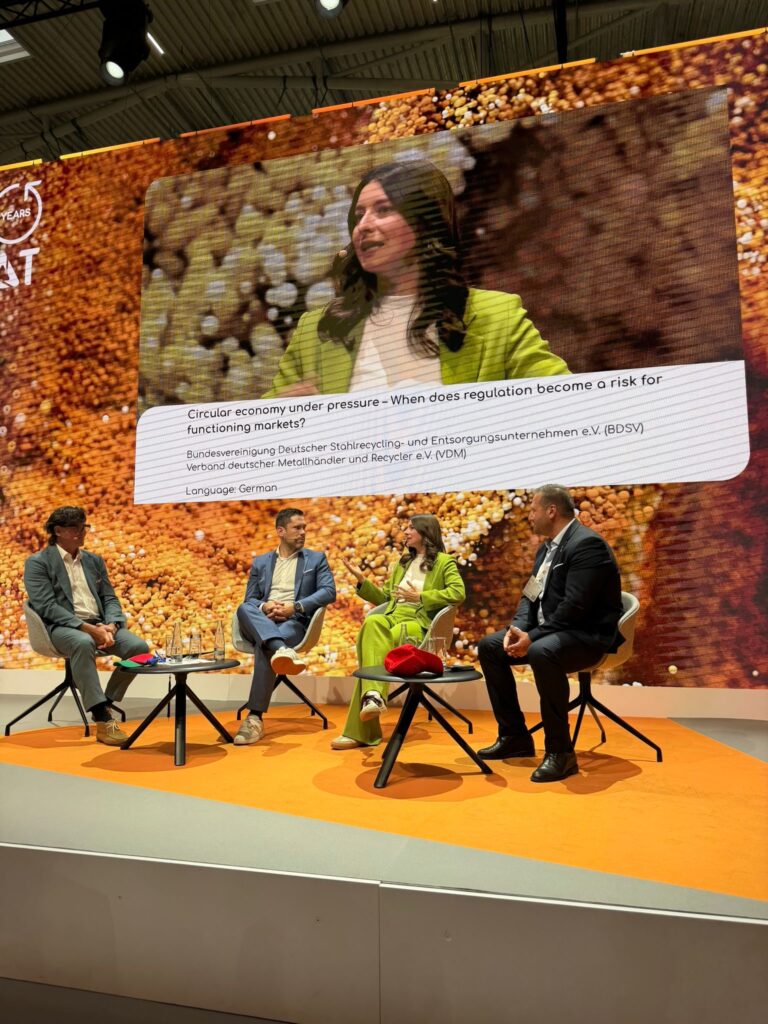
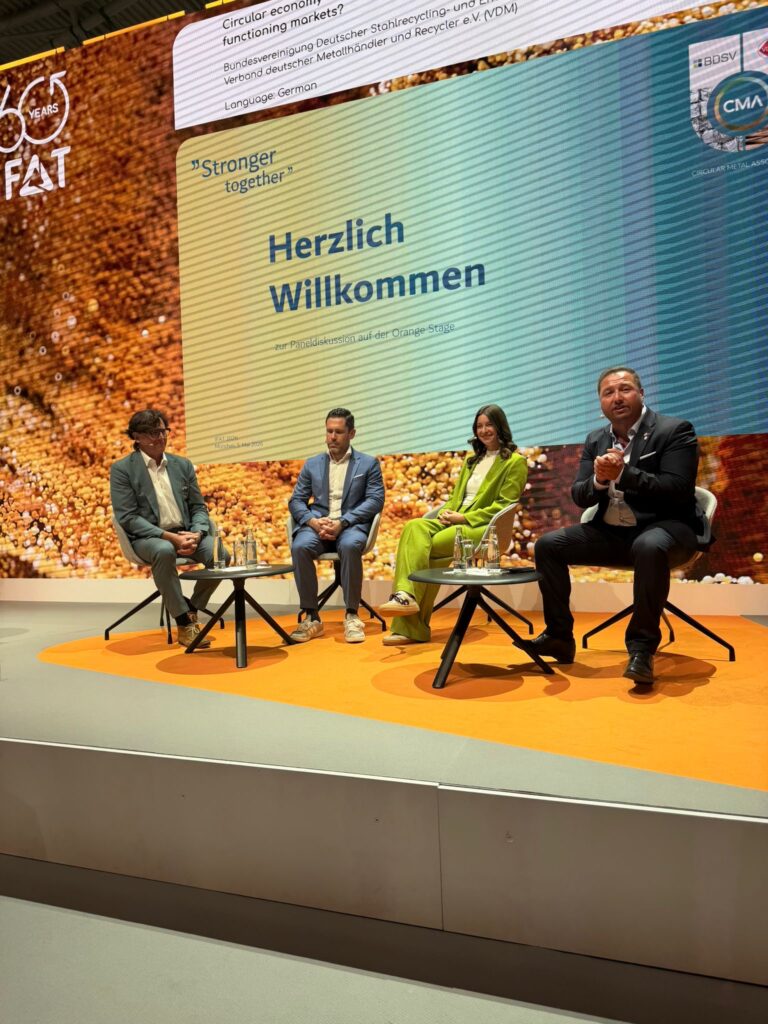
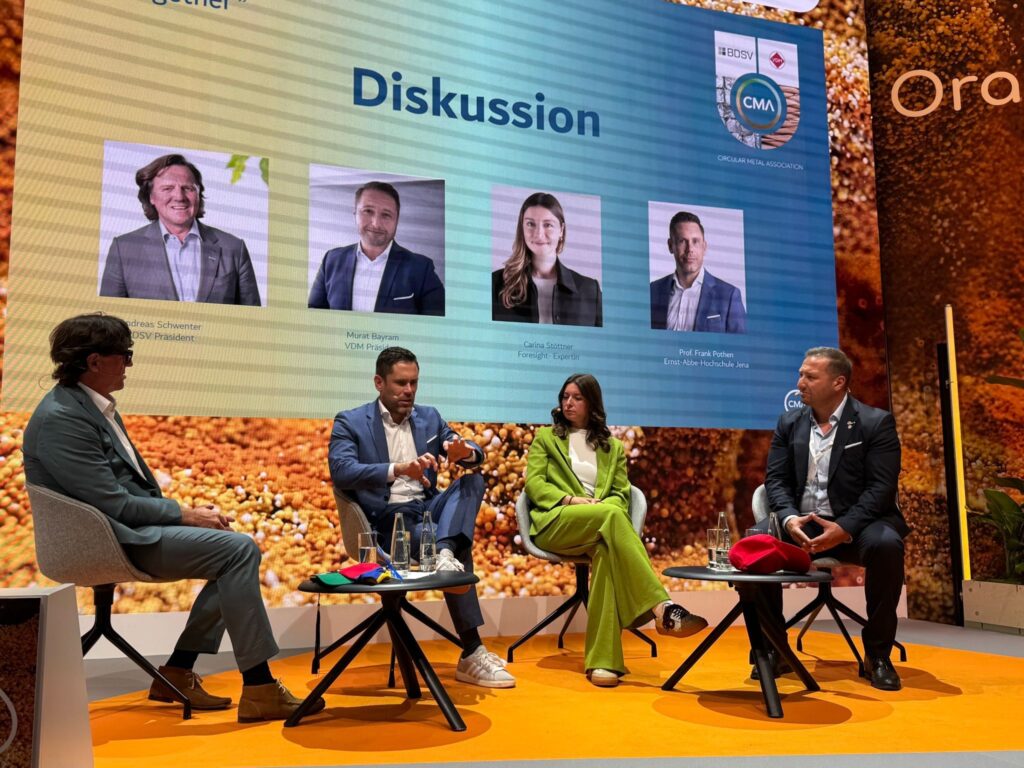
Munich, IFAT 2026 – the world’s leading trade fair for environmental technologies. On stage sit four people negotiating together a question that could hardly be more decisive for Europe’s industrial future: Where is the circular economy heading – toward a highly technologized, globally integrated system? Or are protectionism and geopolitical fragmentation pulling it back from the international stage?
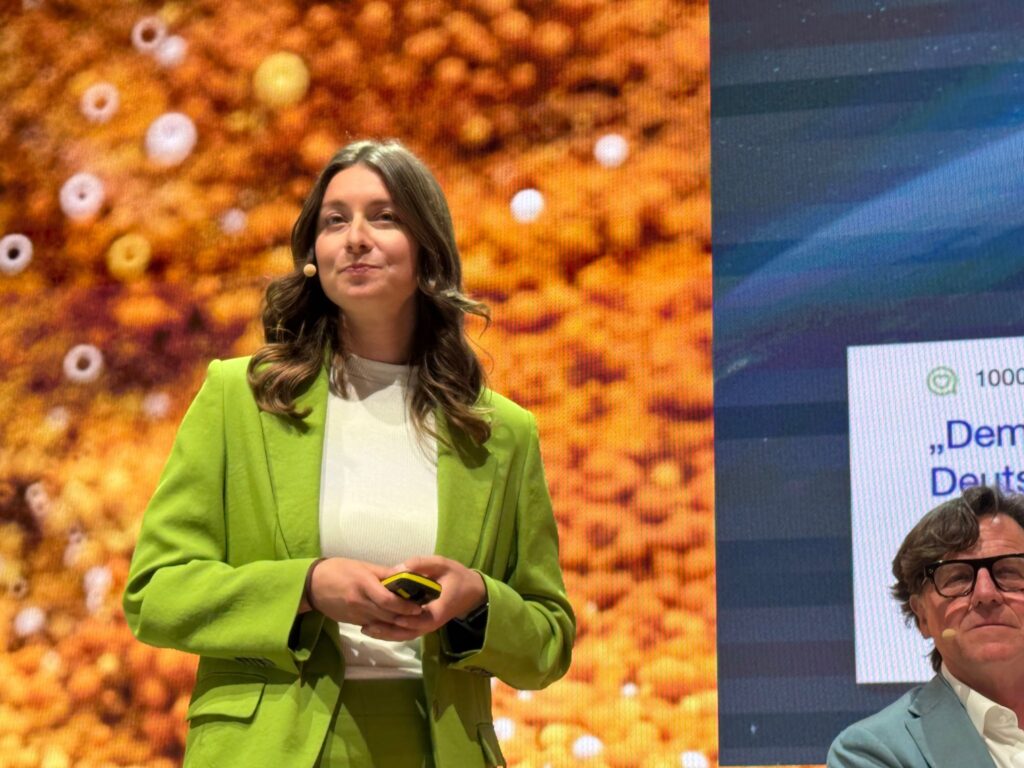
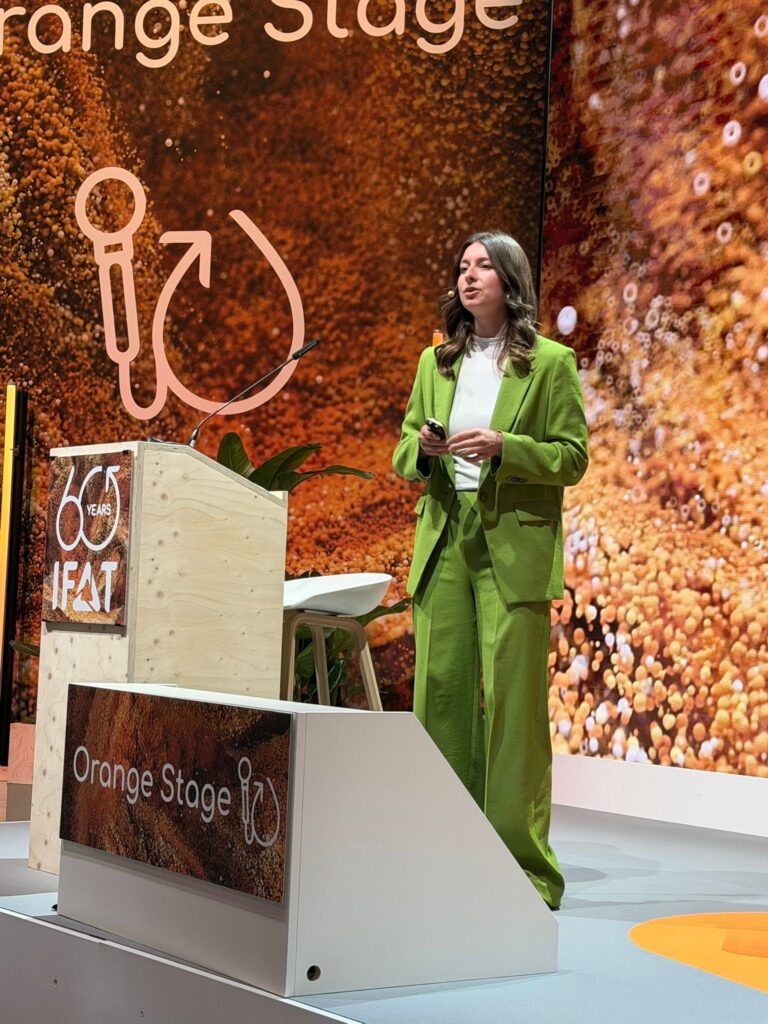
The hosts were the BDSV (German Federation of Steel Recycling and Disposal Companies) and the VDM (Association of German Metal Traders and Recyclers) – two associations that are currently merging into the future Circular Metal Association. On the panel: Murat Bayram, Andreas Schwenter, Prof. Dr. Frank Pothen – and futures researcher Carina Stöttner, whose short keynote set out the framework for the discussion.
What became visible in the process goes far beyond the industry: steel and metal recycling is one of the places where it is decided whether Europe remains industrially sovereign – and whether it does so in a way that is fit for the future.
The underrated industry: What has long existed
Before talking about the future, it is worth looking at the present. In Germany alone, around 10,000 circular economy companies account for about 300,000 jobs. In Europe, the figure runs to several million jobs. Family-run small and medium-sized enterprises, specialized plant manufacturers, highly technologized sorting operations – over the past decades they have invested billions in shredding plants, modern processing technology, and AI-supported sorting.
Murat Bayram’s message on the panel was therefore clear: This industry must stop talking itself down. Recycling operations are not a burden on the environment but, in the words of Andreas Schwenter, environmental protection facilities. They secure raw materials, avoid CO₂, enable green steel, and lay the foundation for industrial value creation in Europe.
Prof. Dr. Frank Pothen provided the economic underpinning: every ton of recycled steel scrap avoids considerable CO₂ emissions. The circular economy is not an accessory to climate policy, but its practical core.
Into this self-understanding Carina Stöttner placed her impulse – and opened up the view ahead.
Stöttner’s scenarios: possible futures for the circular economy
Stöttner’s opening question in the keynote was pointed: Where is our industrial economy heading? And what does that mean for the steel, metal, and recycling industry?
- Scenario A – High-tech circular economy. A globally integrated circular economy in which AI sorting, robotics, new materials sciences, digital material passports, and international cooperation work together. Recycling rates rise drastically, the quality of secondary raw materials reaches primary level, and Europe becomes the technology leader in a growth market.
- Scenario B – customers migrate away and relocate production largely abroad. And with them go raw materials in the form of production scrap, as well as the demand for recycled materials.
- Scenario C – fragmented protective economy. Rising protectionism, new export bans, regional isolation. The industry loses economies of scale, investment power, and innovation pressure. The circular economy does become necessary, but does not turn into a global growth field.
Her message: Which scenario comes to pass is not a forecast. It is a decision. And this decision is being made right now – in Brussels, in Berlin, in supervisory boards, in investment committees.
Deeptech as the future formula of the circular economy
What Stöttner made particularly clear at IFAT: The next stage of the circular economy is a deeptech stage.
In concrete terms, that means:
- AI-supported sorting and material identification, delivering secondary raw materials in qualities that today only primary raw materials achieve
- Robotics in the dismantling of complex products – from electric cars and wind turbines to electronics
- New materials and processes that orient product design toward circularity from the very outset
- International cooperation in research, standards, and trade, because no single market is large enough to bear these investments alone
The trade-off: When protection weakens the very industry it is meant to protect
It was precisely at this point that Stöttner’s keynote interlocked with the pointed position of the associations on the panel. Andreas Schwenter and Murat Bayram were unequivocal on one matter: Protectionism, export bans, and additional trade barriers are not a future strategy.
The logic behind this is not ideological, but rooted in industrial reality:
- Those who seal off markets deprive the industry of investment power. Recycling technology scales only with global sales markets – not with national residual volumes.
- Those who restrict scrap exports slow innovation. International competition is precisely what has made the German recycling industry into the leading position it holds today.
- Those who bet on self-sufficiency lose quality. Secondary raw materials require specialization, sorting purity, and international material flows. Closed systems produce lower qualities at higher prices.
- Those who overload the Mittelstand with bureaucracy weaken the backbone of the circular economy. The ten thousand companies that carry the system need framework conditions that enable – not hold back.
That does not mean: no sovereignty. It means: smart sovereignty instead of a protective-wall reflex. Strategic reserves, diversification of critical material flows, European standards – yes. Long-term, blanket export bans and new walls – no.
Stöttner’s contribution to this: An industry that hunkers down gains short-term security and loses long-term future. The desirable circular economy is open, cooperative, and technologically ambitious – not defensive.
What the industry needs now: less nostalgia, more courage
From the panel and Stöttner’s keynote, four imperatives for the coming years could be distilled – not as finished answers, but as the right questions:
- Self-confidence instead of justification mode. For decades, the industry has been solving in practice what others demand in theory. This achievement belongs in the public narrative about climate protection and industrial sovereignty.
- Deeptech investments now. AI, robotics, new materials, and digital traceability are no longer pilot projects. They are the foundational technologies of the sector for the next twenty years.
- Framework conditions that enable. Reducing bureaucracy, faster approval procedures, reliable energy and trade policy – so that investments can take place in Europe rather than elsewhere.
- International cooperation as a strategy. European strength does not arise from going it alone, but in alliance with global partners, shared standards, and open markets – while maintaining sovereignty in genuine key areas.
The announced merger of BDSV and VDM into the Circular Metal Association fits precisely into this line: more clout, more unity, more future – and an industry that is finally positioning itself the way it has long been set up.
Conclusion: The future of the circular economy can be shaped
Stöttner’s central message at IFAT: The future is not predetermined. It can be shaped.
Whether Europe builds a global high-tech circular economy or retreats into a fragmented protective economy will not be decided in forecasts. It will be decided in the next rounds of investment, in the next wave of European regulation, in the question of whether the industry takes its own strength seriously – and whether politics has the courage to open up spaces of possibility rather than close them.
About the event
The IFAT in Munich is the world’s leading trade fair for water, wastewater, waste, and raw materials management. On the joint stage format of BDSV and VDM – the associations of the steel and metal recycling industry that are merging into the Circular Metal Association – the following took part in the discussion:
- Carina Stöttner, futures researcher, CEO futurewise company
- Murat Bayram, President, VDM
- Andreas Schwenter, President, BDSV
- Prof. Dr. Frank Pothen, Professor of economics at the University of Applied Sciences (Ernst-Abbe-Hochschule) in Jena