Zum Hauptinhalt springen

Foresight: Bedeutung, Methoden und Nutzen einfach erklärt

Foresight begegnet einem heute in Stellenanzeigen, Strategiepapieren und Innovationsabteilungen. Doch was steckt hinter dem Begriff? Dieser Artikel erklärt die Bedeutung von Foresight, grenzt ihn von Prognose und Trendforschung ab und zeigt, mit welchen Methoden Organisationen vorausschauend arbeiten.

Das Wichtigste in Kürze

  • Foresight bedeutet wörtlich Weitsicht oder Vorausschau.
  • Als Fachbegriff steht es für die systematische Auseinandersetzung mit mehreren möglichen Zukünften.
  • Ziel ist nicht die richtige Vorhersage, sondern die bessere Entscheidung heute.
  • Zentrale Methoden: Horizon Scanning, STEEP-Analyse, Szenariotechnik, Delphi, Backcasting, Roadmapping.

Was bedeutet Foresight?

Foresight stammt aus dem Englischen und bedeutet wörtlich übersetzt Weitsicht, Voraussicht oder Vorausschau. Das Gegenstück ist hindsight, also die Rückschau im Nachhinein.

Im deutschsprachigen Raum wird der Begriff meist nicht übersetzt, weil er inzwischen als Fachbegriff etabliert ist. Gemeint ist dann kein persönliches Talent, sondern ein strukturiertes Vorgehen:

Kurzdefinition: Foresight ist die systematische Auseinandersetzung mit möglichen Zukünften, um daraus heute bessere Entscheidungen abzuleiten.

Entscheidend an dieser Definition sind zwei Punkte. Erstens der Plural: Foresight fragt nicht nach der Zukunft, sondern nach mehreren denkbaren Entwicklungen. Zweitens der Gegenwartsbezug. Ziel ist nicht, die Zukunft korrekt vorherzusagen, sondern die eigene Handlungsfähigkeit zu erhöhen.

Wortherkunft und Verbreitung

Das Wort setzt sich zusammen aus fore (voraus) und sight (Sicht) und ist im Englischen seit dem Mittelalter belegt. Als Fachbegriff verbreitete es sich ab den 1970er Jahren, als Japan begann, regelmäßig nationale Delphi-Studien zu Technologieentwicklungen durchzuführen. In den 1990er Jahren folgten staatliche Foresight-Programme in Großbritannien, Deutschland und auf EU-Ebene. Seither hat sich der Ansatz von der Technologiepolitik in Unternehmen, NGOs und Verwaltungen ausgebreitet.

Zwei Bedeutungsebenen

Je nach Kontext meint Foresight etwas anderes:

  • Alltagssprachlich beschreibt Foresight eine Eigenschaft von Menschen. Wer Foresight besitzt, denkt voraus, erkennt Konsequenzen früh und trifft entsprechend Vorkehrungen.
  • Fachlich bezeichnet Foresight eine Disziplin mit eigenen Methoden, Rollen und Prozessen. Sie ist Teil der Zukunftsforschung und wird je nach Anwendungsfeld näher bestimmt: Strategic Foresight, Corporate Foresight, Technology Foresight oder Policy Foresight.

Foresight, Prognose und Trendforschung im Vergleich

Die Begriffe werden häufig vermischt, meinen aber Unterschiedliches.

AnsatzLeitfrageZeithorizontErgebnis
Prognose / ForecastingWas wird am wahrscheinlichsten eintreten?kurz- bis mittelfristigeine Zahl, ein Wert, ein Korridor
TrendforschungWelche Entwicklungen sind bereits sichtbar?laufendbeschriebene Trends und Muster
ForesightWas könnte alles eintreten und was bedeutet das für uns?mittel- bis langfristigmehrere Zukunftsbilder plus Handlungsoptionen
VisionWelche Zukunft wollen wir erreichen?langfristigein angestrebtes Zielbild
Foresight im Vergleich zu Forecasting, Trendforschung und Vision.

Eine Absatzprognose für das kommende Quartal ist Forecasting. Die Frage, wie das eigene Geschäftsmodell in zehn Jahren unter vier sehr unterschiedlichen Rahmenbedingungen aussehen müsste, ist Foresight.

Strategic Foresight und Corporate Foresight

Strategic Foresight verbindet Zukunftsarbeit direkt mit der Strategieentwicklung. Die Erkenntnisse fließen in Portfolioentscheidungen, Investitionen und Risikomanagement ein, statt in einer Studie zu enden.

Corporate Foresight bezeichnet die dauerhafte Verankerung dieser Arbeit im Unternehmen, etwa durch ein eigenes Team, ein Trendradar oder feste Formate im Führungskreis.

Studien zur Zukunftsfähigkeit von Unternehmen zeigen ein wiederkehrendes Muster: Organisationen, die Umfeldveränderungen früh erfassen und intern anschlussfähig aufbereiten, reagieren schneller auf Marktbrüche als Wettbewerber ohne solche Strukturen.

Warum Foresight an Bedeutung gewinnt

Mehrere Entwicklungen erhöhen den Bedarf an vorausschauendem Arbeiten:

  • Kürzere Innovationszyklen, besonders durch Künstliche Intelligenz und Automatisierung
  • Regulatorische Dynamik, etwa bei Nachhaltigkeit, Lieferketten und Datenschutz
  • Geopolitische Unsicherheit mit direkten Folgen für Beschaffung und Absatzmärkte
  • Demografischer Wandel und veränderte Erwartungen an Arbeit
  • Klimawandel mit physischen und transitorischen Risiken

In solchen Umfeldern verliert die Fortschreibung der Vergangenheit an Aussagekraft. Genau dort setzt Foresight an.

Die wichtigsten Foresight-Methoden

Horizon Scanning

Systematisches Beobachten von Signalen aus Wissenschaft, Politik, Technologie und Gesellschaft. Ziel ist es, schwache Signale zu erfassen, bevor sie zum Trend werden.

STEEP-Analyse

Strukturierung des Umfelds nach den Dimensionen Society, Technology, Economy, Ecology und Politics. Sie verhindert, dass die Analyse auf die eigene Branche verengt wird.

Szenariotechnik

Die bekannteste Foresight-Methode. Aus den zentralen Unsicherheiten werden meist drei bis vier in sich stimmige Zukunftsbilder entwickelt, die anschließend gegen die eigene Strategie getestet werden.

Delphi-Befragung

Mehrstufige, anonyme Expertenbefragung. Nach jeder Runde erhalten die Teilnehmenden die aggregierten Ergebnisse und können ihre Einschätzung überdenken.

Wild Cards und Schwarze Schwäne

Ereignisse mit geringer Eintrittswahrscheinlichkeit und großer Wirkung. Sie werden bewusst durchgespielt, um blinde Flecken sichtbar zu machen.

Backcasting

Der Weg führt vom Zielbild rückwärts in die Gegenwart. Die Frage lautet: Was müsste bis wann geschehen sein, damit dieser Zustand eintritt?

Roadmapping

Übersetzt Zukunftsbilder in konkrete Meilensteine für Technologie, Produkt und Kompetenzaufbau.

Wie ein Foresight-Prozess abläuft

  1. Rahmen setzen. Entscheidungsfrage, Zeithorizont und Betrachtungsfeld festlegen.
  2. Scannen. Signale, Daten und Expertenwissen sammeln.
  3. Analysieren. Treiber und Unsicherheiten identifizieren und bewerten.
  4. Zukünfte entwerfen. Szenarien oder Zukunftsbilder ausarbeiten.
  5. Ableiten. Strategische Optionen, Frühindikatoren und nächste Schritte definieren.

Der fünfte Schritt entscheidet über den Nutzen. Ohne Anbindung an reale Entscheidungen bleibt Foresight ein Workshop-Erlebnis.

Typische Fehler

  • Foresight als Vorhersage missverstehen und am Ende nur ein Szenario weiterverfolgen
  • Zu kurzer Zeithorizont, der die Analyse auf bestehende Planungen zusammenschrumpfen lässt
  • Ausschließlich interne Perspektiven einbeziehen
  • Ergebnisse dokumentieren, aber keine Verantwortlichkeiten und Frühindikatoren festlegen
  • Den Prozess einmalig durchführen statt regelmäßig zu aktualisieren

Häufige Fragen zur Bedeutung von Foresight

Was bedeutet Foresight auf Deutsch?

Foresight bedeutet Weitsicht, Voraussicht oder Vorausschau. Als Fachbegriff steht es für die systematische Beschäftigung mit möglichen Zukünften.

Was ist der Unterschied zwischen Foresight und Forecasting?

Forecasting berechnet die wahrscheinlichste Entwicklung einer Größe. Foresight arbeitet mit mehreren möglichen Zukünften und fragt nach den Konsequenzen für das eigene Handeln.

Ist Foresight dasselbe wie Zukunftsforschung?

Zukunftsforschung ist der übergeordnete Begriff für die wissenschaftliche Beschäftigung mit Zukunft. Foresight bezeichnet die anwendungsorientierte Praxis innerhalb dieses Feldes.

Was macht ein Foresight Manager?

Er beobachtet das Unternehmensumfeld, moderiert Szenario- und Strategieprozesse, pflegt Trendradare und übersetzt Erkenntnisse in Empfehlungen für die Führungsebene.

Für welche Organisationen lohnt sich Foresight?

Für alle mit langen Investitionszyklen, hoher Regulierungsdichte oder schnellem technologischem Wandel. Kleinere Organisationen können bereits mit einem schlanken Trendradar und einem jährlichen Szenario-Workshop starten.

Fazit

Die Bedeutung von Foresight lässt sich auf eine Formel bringen: nicht die Zukunft vorhersagen, sondern auf mehrere Zukünfte vorbereitet sein. Wer Umfeldsignale strukturiert erfasst, in Szenarien übersetzt und daraus überprüfbare Handlungsoptionen ableitet, verschafft sich Reaktionszeit. Genau darin liegt der praktische Wert dieser Disziplin.

Die besten Foresight-Methoden für Unternehmen

Die Zukunft ist nicht vorhersehbar – aber sie lässt sich vorausschauend gestalten. Gerade für KMU, Hidden Champions und international tätige Konzerne ist es entscheidend, Veränderungen frühzeitig zu erkennen und unter Unsicherheit handlungsfähig zu bleiben. Die Futurewise Company arbeitet dafür mit bewährten und innovativen Methoden der strategischen Zukunftsforschung. Im Zentrum steht stets die Frage: Wie werden aus heutigen Signalen, Trends und Unsicherheiten tragfähige Entscheidungen für morgen?

Welche Methode dabei sinnvoll ist, hängt von der strategischen Fragestellung ab: Geht es um neue Wachstumsmärkte, technologische Umbrüche, die Zukunft eines Geschäftsmodells oder die langfristige Ausrichtung eines gesamten Unternehmens? Hier finden Sie einen Überblick über die Foresight-Methoden, mit denen wir bei der Futurewise Company regelmäßig arbeiten.

Delphi-Methode

Was ist die Delphi-Methode?

Delphi ist eine qualitative Methode der Zukunftsforschung. In einem mehrstufigen Verfahren werden Expert:innen aus unterschiedlichen Bereichen systematisch zu möglichen Zukunftsentwicklungen befragt. Die Methode wurde vom RAND Think Tank entwickelt und trägt den Namen des antiken Orakels von Delphi.

Im ersten Schritt führen wir Tiefeninterviews mit einem sorgfältig ausgewählten Panel von meist 15 bis 35 Expert:innen. Ihre Aussagen verdichten wir zu Hypothesen, die in einer zweiten Runde anonymisiert bewertet und kommentiert werden. So entsteht ein fundiertes Bild möglicher Entwicklungen – einschließlich abweichender Einschätzungen, blinder Flecken und strategisch relevanter Unsicherheiten.

Wofür eignet sich Delphi?

  • Zur Erweiterung der eigenen Perspektive über Branchen- und Unternehmensgrenzen hinweg
  • Zur Bewertung von Trends, Technologien und zukünftigen Marktveränderungen
  • Zur strategischen Orientierung bei hoher Unsicherheit

Aus der Praxis

Wir nutzen die Delphi-Methode, wenn Geschäftsführungen und Führungsteams ein strategisches Thema tiefer durchdringen möchten: Wo liegen künftige Wachstumsfelder? Wie verändern sich Kundenanforderungen, Wertschöpfungsketten oder regulatorische Rahmenbedingungen? Und welche Risiken werden im heutigen Tagesgeschäft noch unterschätzt?

Dafür sprechen wir beispielsweise mit Vertreter:innen aus Wissenschaft und Politik, bestehenden oder potenziellen Kunden, Branchenexpert:innen, Start-ups und anderen Unternehmen. Für einen Hidden Champion kann es darum gehen, die Zukunft einer hochspezialisierten Technologie zu bewerten. Ein KMU möchte vielleicht herausfinden, welche neuen Kundengruppen mit den vorhandenen Kompetenzen erschlossen werden können. Auf Konzernebene kann Delphi helfen, unterschiedliche Perspektiven auf ein Zukunftsthema systematisch zusammenzuführen. Die wertvollsten Erkenntnisse finden sich dabei häufig nicht in Schlagzeilen oder Studien, sondern entstehen im direkten Austausch mit Menschen, die an technologischen, politischen oder gesellschaftlichen Veränderungen arbeiten.

Szenario-Analyse

Was ist die Szenario-Analyse?

Szenarien sind narrative, plausible Zukunftsbilder, die auf Annahmen, Treibern und zentralen Unsicherheiten basieren. Sie helfen Unternehmen, mehrere mögliche Zukunftspfade zu verstehen, anstatt ihre Strategie ausschließlich auf eine erwartete Entwicklung auszurichten.

Die unter anderem von Herman Kahn geprägte und durch Shell bekannt gewordene Methode ermöglicht es, unterschiedliche Entwicklungen und ihre Konsequenzen für Märkte, Geschäftsmodelle, Investitionen und Organisationen systematisch durchzuspielen.

Wofür eignen sich Szenarien?

  • Zur Entwicklung robuster strategischer Handlungsoptionen
  • Zur Vorbereitung auf Unsicherheit und disruptive Veränderungen
  • Zur gemeinsamen Diskussion komplexer Zukunftsbilder in Führungsteams

Aus der Praxis

Es gibt Dutzende Methoden, um Szenarien zu entwickeln. Im Video unten werden drei davon kurz erklärt. Kompakte Ansätze wie die 2×2-Matrix eignen sich, um eine konkrete strategische Frage effizient aus verschiedenen Richtungen zu beleuchten: Was passiert, wenn die Kaufkraft eines zentralen Kundensegments wächst – und was, wenn sie stagniert? Was, wenn die Nachfrage nach einer neuen Technologie eine Nische bleibt – und was, wenn daraus ein Massenmarkt wird?

Für inhabergeführte KMU schafft dies eine strukturierte Grundlage für wichtige Investitionsentscheidungen. Hidden Champions können prüfen, wie robust ihre Spezialisierung gegenüber technologischen oder geopolitischen Veränderungen ist. Konzernleitungen nutzen umfassendere Szenarien beispielsweise, um Portfolios, Regionen oder Geschäftsbereiche unter unterschiedlichen Zukunftsbedingungen zu bewerten. Besonders in kontroversen Strategiediskussionen helfen Szenarien dabei, Abstand von persönlichen Überzeugungen zu gewinnen und mehrere plausible Entwicklungen möglichst sachlich zu betrachten.

Backcasting

Was ist Backcasting?

Backcasting beginnt nicht in der Gegenwart, sondern in einer wünschenswerten Zukunft. Von einem klaren Zukunftsbild aus werden die notwendigen Schritte systematisch bis in die Gegenwart zurückgedacht. Das eröffnet neue Perspektiven und verhindert, dass langfristige Strategien lediglich zu einer Fortschreibung des heutigen Geschäfts werden.

Gemeinsam mit Geschäftsführungen und Führungsteams entwickeln wir ein konkretes Zukunftsbild und leiten daraus kurz-, mittel- und langfristige Entscheidungen, Meilensteine und Verantwortlichkeiten ab.

Wofür eignet sich Backcasting?

  • Zur Entwicklung ambitionierter und zugleich umsetzbarer Strategien
  • Zur Überwindung kurzfristiger und rein reaktiver Planung
  • Zur Ausrichtung von Innovations-, Wachstums- und Transformationsprozessen

Aus der Praxis

Über Zukunft zu sprechen, erzeugt meist viele gute Ideen. Im operativen Alltag fehlen jedoch schnell Zeit, Ressourcen und klare Zuständigkeiten für langfristige Themen. Backcasting schafft hier Verbindlichkeit: Wenn ein Unternehmen bis zu einem bestimmten Zeitpunkt ein Zukunftsziel erreichen will, welche Voraussetzungen müssen dann drei, fünf oder zehn Jahre vorher geschaffen sein?

Für KMU übersetzt die Methode große Ambitionen in realistische Schritte, die zu den verfügbaren Ressourcen passen. Hidden Champions können damit frühzeitig Kompetenzen, Partnerschaften und Technologien aufbauen, die ihre Marktposition langfristig sichern. In Konzernen hilft Backcasting, ein gemeinsames Zukunftsbild mit konkreten Transformationspfaden für Geschäftsbereiche, Funktionen und Regionen zu verbinden.

Futures Triangle

Was ist das Futures Triangle?

Das von Sohail Inayatullah entwickelte Futures Triangle analysiert drei Kräfte, die jede Zukunft beeinflussen:

  • Push: Treiber und Veränderungen der Gegenwart
  • Pull: attraktive Zukunftsbilder und gemeinsame Ambitionen
  • Weight: bremsende Strukturen, Erfahrungen und Denkmuster aus der Vergangenheit

Die Methode macht sichtbar, in welchem Spannungsfeld sich eine strategische Entscheidung bewegt – und warum eine Veränderung trotz guter Argumente möglicherweise nicht vorankommt.

Wofür eignet sich das Futures Triangle?

  • Zur Analyse widersprüchlicher Zukunftsanforderungen
  • Zur strategischen Priorisierung
  • Zur Reflexion kultureller, struktureller und historischer Blockaden

Aus der Praxis

„Dieses Thema haben wir vor drei Jahren schon einmal diskutiert. Damals hat es nicht funktioniert – deshalb fassen wir es heute nicht mehr an.“ Solche Sätze begegnen uns in Unternehmen jeder Größe. Das Futures Triangle hilft, dahinterliegende Erfahrungen und Glaubenssätze sichtbar zu machen und zu prüfen, ob sie unter veränderten Bedingungen noch gültig sind.

In Familienunternehmen und KMU können etwa gewachsene Entscheidungswege oder knappe Ressourcen eine Zukunftsinitiative bremsen. Bei Hidden Champions steht mitunter die bisher sehr erfolgreiche Spezialisierung einer notwendigen Neuausrichtung im Weg. In Konzernen können Strukturen, Zielsysteme oder frühere Transformationsprogramme verhindern, dass ein überzeugendes Zukunftsbild Wirkung entfaltet. Gleichzeitig hilft die Methode, gehypte Trends kritisch einzuordnen: Handelt es sich um einen kurzfristigen Sog – oder um eine Entwicklung, auf die das Unternehmen strategisch reagieren sollte?

Futures Wheel

Was ist ein Futures Wheel?

Das von Jerome C. Glenn entwickelte Futures Wheel ist ein visuelles Denkwerkzeug, mit dem direkte und indirekte Folgen eines Ereignisses, Trends oder einer strategischen Entscheidung systematisch erfasst werden.

Im Zentrum steht ein Impuls, beispielsweise eine technologische Innovation, eine regulatorische Veränderung oder ein neues Kundenverhalten. Davon ausgehend betrachten wir in mehreren Ringen Auswirkungen erster, zweiter und dritter Ordnung.

Wofür eignet sich das Futures Wheel?

  • Zur systemischen Analyse neuer Entwicklungen
  • Zur Einbindung unterschiedlicher Funktionen und Führungsebenen
  • Zur frühzeitigen Identifikation von Chancen, Risiken und unbeabsichtigten Folgen

Aus der Praxis

Die erste Auswirkung eines Trends ist meist schnell benannt: KI wird beispielsweise Teile der Arbeit von Grafikdesigner:innen übernehmen. Für strategische Entscheidungen reicht diese Aussage jedoch nicht aus. Entscheidend ist, was danach passiert: Können Designer:innen künftig zehn statt eines Auftrags bearbeiten? Erwarten Kunden dadurch niedrigere Preise und kürzere Lieferzeiten? Werden Kreative zu Manager:innen paralleler KI-Prozesse? Und welche Folgen hat das für Qualifikationen, Führung, Arbeitsbelastung und die Organisation von Agenturen?

Ein Futures Wheel hilft KMU dabei, die betrieblichen Folgen eines Trends frühzeitig und mit überschaubarem Aufwand zu erfassen. Hidden Champions können Auswirkungen auf Produkte, Kunden, Kompetenzen und Lieferketten miteinander verbinden. Konzernleitungen nutzen die Methode, um Wechselwirkungen zwischen Geschäftsbereichen, Märkten und Funktionen sichtbar zu machen. So wird aus einem abstrakten Trend eine konkrete strategische Fragestellung.

Trendradar

Was ist ein Trendradar?

Ein Trendradar ist ein strukturiertes Analyseinstrument, das relevante Trends, Signale und mögliche Umbrüche systematisch erfasst, bewertet und für die Strategiearbeit aufbereitet. Die Entwicklungen werden beispielsweise nach Relevanz, Zeithorizont und Unsicherheit eingeordnet und übersichtlich visualisiert.

Wir entwickeln Trendradare für Branchen, Technologien und unternehmensspezifische Fragestellungen – etwa zur Zukunft von Arbeit, Industrie, Mobilität oder Nachhaltigkeit. Entscheidend ist dabei nicht die größtmögliche Sammlung von Trends, sondern ihre Bedeutung für das jeweilige Unternehmen.

Wofür eignet sich ein Trendradar?

  • Zur strategischen Früherkennung
  • Zur Identifikation und Priorisierung neuer Innovations- und Wachstumsfelder
  • Zur verständlichen Kommunikation von Zukunftswissen im Unternehmen

Aus der Praxis

Für KMU schafft ein fokussiertes Trendradar Orientierung, ohne zusätzliche Informationsflut zu erzeugen. Hidden Champions können damit Entwicklungen außerhalb ihres angestammten Marktes beobachten, die ihre Technologieführerschaft oder Kundenzugänge verändern könnten. In Konzernen schafft ein gemeinsames Radar eine belastbare Grundlage, um Zukunftsthemen über Geschäftsbereiche hinweg zu bewerten, Verantwortlichkeiten festzulegen und strategische Prioritäten regelmäßig zu überprüfen.

Sie möchten herausfinden, welche Foresight-Methode zu Ihrer strategischen Fragestellung und Ihrer Organisation passt? Die Futurewise Company unterstützt KMU, Hidden Champions und Konzernleitungen bei der Auswahl, Durchführung und Übersetzung der Ergebnisse in konkrete strategische Entscheidungen.

What Shell Knew Before the Crisis Hit

When the oil crisis struck in 1973, most companies were caught flat-footed. Shell wasn’t. They’d already spent two years thinking through how they’d need to adapt.

Why? Because back in 1971, two senior Shell managers dared to ask a simple question: what would happen if oil prices swung dramatically?*

The scenarios they built weren’t great forecasts. Their price estimates were set far too low. But it didn’t matter — and that’s the whole point. Whether oil tripled or quadrupled, the consequences rhymed: a wobbling economy, social tension and fuel theft, shifting mobility paradigms (remember car-free Sundays?), a push toward diversified supply chains, and new pricing policies.

Shell had already reasoned through those consequences. So when the shock came, they weren’t panicking, but rather already in the execution mode.

Thinking in scenarios

Thinking in scenarios is far more than playing out the single most likely outcome. It means:

  • Reasoning through many possible futures, not just one.
  • Continuously adapting your strategy, because you’ve learned to watch for the signals that one future or another is emerging.
  • A huge cultural shift — building an organization that welcomes people asking challenging questions, rather than punishing it.

That last point is the hard one. Asking „What if a pandemic shuts down the country?“, „What if kerosene is no longer available?“, or „What if the Rhine becomes unnavigable?“ isn’t always welcome. It requires leaders willing to engage seriously with divergent futures — and, in doing so, to admit they don’t have 100% certainty about the years ahead.

That admission is uncomfortable. It’s also exactly what let Shell move while everyone else was still reacting.

*How it all played out at Shell is told by Dr. Henk Alkema in a video: https://www.youtube.com/watch?v=m9WZQU8_HnA

Wild Cards in Foresight and Future Planning

Remember the spring of 2020? For about six months, you couldn’t open a newspaper, a LinkedIn feed, or a quarterly earnings call without somebody, somewhere, calling the pandemic a „black swan event.“ Politicians used it to suggest that no reasonable government could have been expected to prepare for the thing that had, in fact, been war-gamed repeatedly by public health agencies for over a decade.

The phrase did a lot of work in those months, most of it apologetic. A black swan, in the way the term was thrown around, was something nobody could have seen coming, which conveniently meant that nobody could really be blamed for failing to see it coming. The trouble is that Nassim Nicholas Taleb, who popularized the idea, was almost immediately on television and in op-eds explaining that COVID-19 was not a black swan at all. Pandemics had been forecast. The warning signs were on the record. What was actually surprising wasn’t the event but the discovery, in real time, of how fragile the supply chains, the hospitals, and the political institutions turned out to be when the predictable thing finally happened.

That whole episode is a useful way into a much older idea from the world of strategic foresight, one that predates Taleb by a decade and a half and that, in some ways, captures what we were trying to describe more precisely than the black swan ever did. The idea is called the wild card.

A wild card is a future event with a low probability of occurring and a very high impact if it does. The definition sounds clinical, and it is, but the concept itself is older than most people realize. It was formalized in 1992 by the Copenhagen Institute for Futures Studies, working with BIPE Conseil and the Institute for the Future, and it entered wider circulation in 1997 through John L. Petersen’s book Out of the Blue – Wild Cards and Other Big Future Surprises. Petersen wasn’t claiming to predict the future. He was making a more interesting argument: that any serious planner had a professional obligation to spend at least some time staring at the unlikely corners of the distribution, rather than the comfortable middle where most strategy gets written.

Black swans and wild cards are close relatives. Wild cards live in the working vocabulary of foresight practitioners, who deliberately surface them in scenario exercises, stress tests, and strategy retreats; they are things you put on a whiteboard and argue about. Black swans, in Taleb’s stricter sense, are events that were essentially invisible beforehand and only look inevitable in retrospect.

What sits between them, and what foresight people spend most of their time worrying about, is the question of weak signals. Wild cards rarely arrive in complete silence. They tend to be preceded by fragments of information that look like noise at the time and only become meaningful in hindsight: an oddly worded paper in an obscure journal, a procurement contract in a country nobody is paying attention to, a small shift in the language used by a regulator, a cluster of unusual hospital admissions in a town that doesn’t normally make the news. The hard part is organizational: Most reporting structures inside companies and governments are designed to filter exactly this kind of signal out as irrelevant, because most of the time it is. The discipline of foresight is largely the discipline of building institutions that can hold onto the weird stuff a little longer than instinct suggests they should.

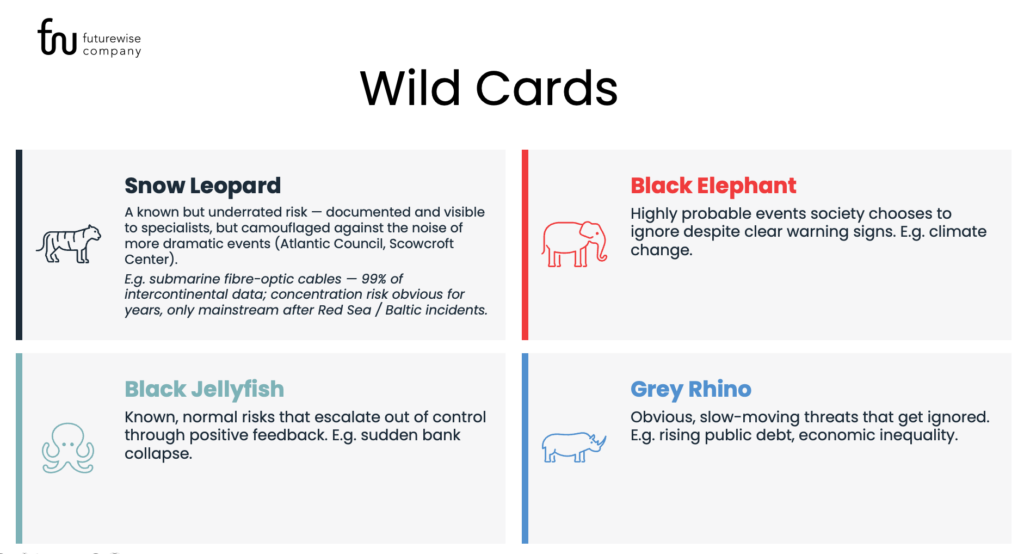
The Four Animals in the Foresight Bestiary

Snow Leopard

A known but underrated phenomenon: documented and visible to specialists, but camouflaged against the noise of more dramatic events and therefore systematically underweighted. The metaphor was developed by the Atlantic Council’s Scowcroft Center for its Global Foresight reports, named for the species‘ disruptive coat pattern that breaks up its outline against Himalayan terrain — the ghost of the mountains. (Some risk-management writers use white leopard for the same idea.)

Example: the vulnerability of submarine fibre-optic cables, which carry roughly 99 percent of intercontinental data and a significant share of global financial settlements. The concentration risk has been documented for years; it took incidents in the Red Sea, the Baltic, and the Taiwan Strait to bring it into mainstream view.

Black Elephant

A high-probability, high-impact event that is already documented and discussed by specialists, but that society chooses to treat as unlikely because acknowledging it would demand uncomfortable change. The term was coined in 2009 by disaster-relief consultant Vinay Gupta and popularized in 2014 by environmentalist Adam Sweidan through Thomas Friedman’s New York Times column. When the elephant finally arrives, it gets relabelled a black swan that nobody could have seen coming.

Example: anthropogenic climate change. The physics has been understood since Arrhenius’s 1896 calculations, the projection literature is consistent across IPCC cycles, and the response has nevertheless behaved as though the problem belongs to a future generation.

Black Jellyfish

A known, ostensibly normal phenomenon that escalates into systemic crisis through positive feedback — a small input that, amplified by interconnected systems, produces effects out of all proportion to its starting scale. The term comes from Ziauddin Sardar’s postnormal times theory and represents „unknown knowns“: phenomena we believe we understand but whose behaviour at scale surprises us.

Example: the 2013 shutdown of Sweden’s Oskarshamn nuclear plant, when Aurelia aurita blooms — driven by warming seas, ocean acidification, and overfishing of jellyfish predators — clogged the cooling intakes and forced a 1,400-megawatt reactor offline.

Grey Rhino

A high-probability, high-impact threat that is large, visible, slow-moving, and consistently ignored despite a complete absence of any information deficit. Introduced by policy analyst Michele Wucker in her 2013 World Economic Forum address and developed in her 2016 book The Gray Rhino. Wucker’s point, against the prevailing fashion for black swan vocabulary, is that most major crises are not surprises at all; the interesting question is why the institutions in their path failed to move.

Example: the 2008 subprime crisis. Shiller’s Irrational Exuberance documented the housing bubble in 2005, the Bank for International Settlements flagged systemic risk in 2006 and 2007, and the FBI warned of a mortgage-fraud „epidemic“ as early as 2004. The rhino was visible from a considerable distance.


The point of wild card thinking isn’t prediction; it’s the cultivation of adaptive capacity, in the same sense biologists and resilience engineers use the term. An organization that has seriously rehearsed the loss of its largest supplier tends to handle the loss of its second-largest one with more composure, even though the specific scenario was wrong, because the underlying flexibility transfers. Beyond that, sitting with the improbable for any length of time tends to bring back into the strategy conversation a set of unfashionable virtues — redundancy, optionality, slack, balance sheet conservatism — that long periods of stability quietly erode, and whose absence is universally regretted in the first quarter after stability ends.

So what does all of this leave us with, after the dust of the past few years has settled and „black swan“ has gone the way of most overused phrases? Mostly a sharper vocabulary, and a slightly more honest one. The wild cards, the elephants, the jellyfish, the leopards, the rhinos — these aren’t predictions and were never meant to be. They are a way of naming the different ways the future tends to escape the assumptions we’ve built our planning on, and a reminder that when the next big surprise lands, the interesting question won’t be whether it was foreseeable. It almost always was, by somebody. The interesting question will be whether anyone in the room had been paying attention.

Thinking in Futures: Scenario Development in Foresight

The future never arrives as a single, predictable line. This is why strategic foresight has largely abandoned the idea of „predicting“ what comes next in favor of something far more useful: developing scenarios – multiple, plausible, internally consistent stories about how the future could unfold.

Scenario development is not about being right, but about being prepared. It helps organizations stretch their imagination, stress-test their strategies, and recognize the early signals of change before competitors do. Below, we’ll walk through what scenario development is, why it matters, and three of the most influential approaches practitioners use today: the Shell scenario method, the 2×2 matrix, and the archetypes approach.

Why Scenarios?

Traditional forecasting extrapolates from the present: take last year’s numbers, adjust for known trends, and project forward. This works reasonably well in stable environments. It fails spectacularly when the world shifts — during pandemics, geopolitical ruptures, technological leaps, or financial crises.

Scenarios are not about the question: „what is most likely?“, but about „what is possible, and what would each possibility mean for us?“ A good set of scenarios captures the genuine uncertainty of the future without dissolving into infinite possibilities. They are tools for decision-making under deep uncertainty, helping leaders see their assumptions, identify blind spots, and build strategies robust across multiple futures.

There are dozens of ways to develop scenarios, so here are the most interesting ones:

The Shell Scenario Approach

No discussion of scenario planning is complete without Royal Dutch Shell. In the late 1960s and early 1970s, Shell’s planners – most famously Pierre Wack – pioneered a method that would become legendary after the company anticipated the 1973 oil crisis when its competitors did not.

The Shell approach is intensive, narrative-driven, and deeply qualitative. It typically begins with framing a strategic question — something concrete enough to matter but broad enough to invite real exploration. From there, planners scan the environment for driving forces: technological, economic, environmental, political, and social factors that shape the issue. These forces are then sorted by importance and uncertainty, and the most critical uncertainties become the backbone of two to four richly developed scenarios.

What makes the Shell method distinctive is its emphasis on storytelling and challenge. Scenarios are not bullet-point lists of conditions; they are coherent, plausible narratives with internal logic, vivid detail, and named characters of change. The goal is to produce stories that surprise executives, force them to confront mental models, and leave a lasting impression. Shell still publishes major scenario studies today, often with multi-decade time horizons exploring energy transitions and geopolitical shifts. The strength of the Shell approach is depth. Its weakness is cost: doing it well takes months of work, skilled facilitators, and senior leadership engagement.

The 2×2 Matrix Method

If the Shell approach is the gold standard, the 2×2 matrix is the workhorse. Developed and popularized by the Global Business Network (GBN) in the 1990s — drawing heavily on Shell’s intellectual heritage — it offers a faster, more accessible way to generate four scenarios that span a meaningful range of futures.

The method is elegant in its simplicity. After identifying the driving forces relevant to the question at hand, the team selects the two most important and most uncertain forces. These become the axes of a matrix. Each axis runs from one extreme to the other (for example, „high regulation“ to „low regulation“), and the four resulting quadrants each describe a distinct future world.

Imagine a company exploring the future of urban mobility. The team might land on two critical uncertainties: the pace of autonomous vehicle adoption (slow vs. fast) and the dominant ownership model (private vs. shared). The four quadrants then yield four very different futures — a world of privately owned self-driving cars, a world of shared autonomous fleets, a world of traditional private ownership, and a world of shared human-driven mobility. Each quadrant gets a name, a narrative, and a set of implications for strategy.

The 2×2 method is widely loved because it is fast, visually intuitive, and produces scenarios that feel meaningfully different. It works well in workshops and is easy to communicate to stakeholders. The trade-off: by collapsing complexity into two axes, it can oversimplify, and the choice of axes carries enormous weight. Pick the wrong two uncertainties and you get four scenarios that feel hollow.

The Archetypes Approach

The archetypes method takes a different starting point. Rather than building scenarios from the ground up via driving forces, it draws on the observation — first made systematically by futurist Jim Dator and developed further by researchers like Sohail Inayatullah and Peter Bishop — that scenario stories tend to cluster around a small number of recurring patterns. Dator’s classic four archetypes are:

Continued Growth — the future as more of the present, with established trends extending forward. Economies expand, technology progresses, institutions persist.

Collapse — systems break down. Environmental, economic, political, or social crises overwhelm existing structures, leading to significant decline or rupture.

Discipline — society organizes around a constraining principle, often in response to limits. Resources, behaviors, or freedoms are deliberately constrained to preserve something deemed essential — sustainability, security, tradition, equality.

Transformation — a fundamental shift in what it means to be human or to organize society, typically driven by technological, spiritual, or values-based change. The post-transformation world operates by different rules entirely.

Practitioners take their core question and write each archetype into a scenario specific to the topic. A study of the future of higher education, for example, would produce a „continued growth“ scenario where universities keep expanding, a „collapse“ scenario where the model breaks under financial and demographic pressure, a „discipline“ scenario where education is reorganized around tighter purposes and constraints, and a „transformation“ scenario where AI, biotechnology, or new social structures redefine learning entirely. The archetypes approach is powerful because it forces teams to consider futures they might otherwise avoid — particularly collapse and transformation, which executives often find uncomfortable. It also produces scenarios that span a genuinely wide possibility space. Its limitation is that the archetypes can feel formulaic if applied mechanically, and they sometimes obscure the specific driving forces shaping a particular issue.

Our Approach at the Futurewise Company

At Futurewise, we don’t believe in one-size-fits-all foresight. Every strategic question carries its own texture — different uncertainties, different stakeholders, different time horizons — and our methodology adapts accordingly. While we draw on the established traditions described above, we typically build scenarios through a tailored sequence that combines several techniques into a coherent process.

We often begin with the Futures Wheel, a structured ideation tool that helps us trace the ripple effects of a change. Starting from a central trigger — a new technology, a regulatory shift, a demographic transition — we map out first-order consequences, then second- and third-order effects radiating outward. This is particularly powerful for surfacing emerging customer needs or identifying problems that haven’t yet appeared on anyone’s radar. If autonomous delivery becomes mainstream, what new anxieties, opportunities, or behaviors does that create two or three steps down the line? The Futures Wheel makes the implicit explicit.

Once we’ve identified emerging needs or problems, we ask the critical follow-up question: under what conditions would these actually emerge? A trend identified in a workshop is not the same as a trend that will materialize in the world. We systematically define the conditions that would have to hold — regulatory environments, technological maturity, consumer trust, infrastructure readiness, geopolitical stability — for each potential development to take shape.

These conditions are then assessed through an impact/uncertainty matrix. Each condition is plotted on two dimensions: how much it would shape the outcome if it occurred (impact), and how unpredictable its trajectory is (uncertainty). The conditions that cluster in the high-impact, high-uncertainty corner become our candidates for scenario axes — because these are precisely the factors where being wrong matters most and where the future genuinely could break in different directions.

From this assessment, we select the most strategically critical uncertainties as our axes and build out scenarios. To pressure-test and enrich these scenarios, we draw on an adapted Delphi Method. The classical Delphi approach gathers expert input through anonymous multi-round surveys until consensus emerges, but we’ve reshaped it to fit the realities of strategic work with executives. Instead of running surveys, we conduct semi-structured 1:1 interviews built around hypotheses derived from our earlier foresight work — the Futures Wheels, the impact/uncertainty assessments, the draft scenario matrices. This format preserves the comparability across experts that makes Delphi valuable, while allowing for the depth, nuance, and unexpected insights that only a real conversation can surface. We then synthesize these expert perspectives to sharpen our scenarios, identify future growth opportunities, and build decision-relevant views on the strategic risks and opportunities our clients face.

Choosing an Approach

These three methods are not in competition. Experienced practitioners often combine them, using the Shell method’s rigor for high-stakes long-term studies, the 2×2 matrix for workshops and rapid strategy sessions, and the archetypes for ensuring breadth of imagination. The right choice depends on the question, the time available, and the audience.

What unites all three is a fundamental commitment: take the future seriously as a space of multiple possibilities, build coherent stories about those possibilities, and use them to make better decisions today. Done well, scenario development does not eliminate uncertainty — it equips you to act wisely within it.

The future will still surprise you. But with good scenarios, fewer of those surprises will be the kind that catch you completely off guard.

The Delphi Method in Foresight – and How We Use It

Originally developed at the RAND Corporation in the 1950s, the Delphi method is a structured way to gather and synthesize expert opinion on questions about the future – particularly where data is scarce and uncertainty is high. It is a multi-stage, survey-based approach used in foresight, typically designed to arrive at a stable assessment through controlled feedback across several rounds, while avoiding the influence of dominant individuals.

In foresight, Delphi is less about asking open questions and more about testing sharply formulated hypotheses about how the future might unfold. It allows us to systematically confront these hypotheses with diverse expert perspectives – across hierarchies, geographies, and sectors – and to understand not only where views converge, but where they meaningfully diverge. The goal is not a single prediction, but a clearer map of plausible futures, underlying assumptions, and critical uncertainties.

At the Futurewise Company, we have adapted the method to fit strategic work with executives. Instead of anonymous multi-round surveys, we run Delphi as semi-structured 1:1 interviews based on hypotheses derived from earlier foresight tools such as Futures Wheels or scenario matrices. This approach preserves comparability across interviews while allowing for depth, nuance, and unexpected insights. We then synthesize these expert perspectives to refine scenarios, explore future growth opportunities, and build decision-relevant views on strategic risks and opportunities.

Starting With Hypotheses

Before we ever talk to an expert, we need to know what we are actually trying to learn. That foundation comes from earlier foresight work — typically a Futures Wheel, a 2×2 scenario matrix, or both.

These tools generate something useful: a map of the drivers, dependencies, and fields that matter for our research question. From that map, we extract two things. First, the topical territory we need to cover. Second, the conditions that are simultaneously high impact and high uncertainty — the places where the future is genuinely unsettled and where expert input will move our thinking the most.

This, for how we conduct Delphi interviews at the Futurewise Company, is the raw material for hypothesis formulation.

A hypothesis like „manufacturing will change in Germany“ is useless. Nobody will disagree with it, and nobody will say anything interesting in response. Compare it to: „In 2036, most manufacturing and production will be outsourced. What remains in Germany is R&D only.“

That version is specific. It commits to a timeframe, a geography, and a structural claim. It is also slightly provocative — and that is intentional. Vague hypotheses get vague answers. Provocative hypotheses force experts to either defend or dismantle the claim, and either response gives you signal.

The rule we follow: be specific, and lean toward the provocative end. If your hypothesis could be the headline of a contrarian opinion piece, you are probably in the right zone.

Choosing the Right Experts

Once the hypotheses are sharp, we work backwards from them to figure out who needs to weigh in. A good Delphi panel is not just „smart people we can reach.“ It is a deliberately structured group designed to surface different angles on the same question.

We think about diversity along several axes:

  • Hierarchy. Strategic voices (C-suite, policy leads) see the system. Operational voices (engineers, plant managers, frontline analysts) see the friction. Both are necessary, and they often disagree in productive ways.
  • Geography. A question about German manufacturing looks different from Munich, Shenzhen, and Detroit.
  • Organizational background. We aim for a mix across academia, government, media, industry, civil society, think tanks, and consultancies. Each sector carries its own incentives and blind spots, and the contrast is where insight lives.

The goal is not balance for its own sake. It is to make sure that when consensus does emerge, it is meaningful – and when disagreement emerges, we know exactly which fault lines are doing the work.

Finding and Reaching Experts

The hardest part is often just getting people to talk to you. A few channels work consistently for us:

LinkedIn is the obvious starting point, but the higher-yield move is browsing speaker lists from relevant conferences. People who agree to speak publicly on a topic are, by definition, experts in their field and willing to talk about it — a rarer combination than it sounds.

Internal networks are underrated. Your CEO, your shareholders, and your sales team often have networks that took decades to build. Use them. A warm introduction from them beats a cold message every time.

Beyond that: scientists who have published recently in the area, VCs investing in the space (they have done their own diligence and are usually happy to share a slice of it), and journalists covering the beat. Journalists in particular tend to know a lot of people and have a strong sense of who is worth listening to versus who is just loud.

Designing the Questions

Generic questions produce generic answers. The framing techniques below are designed to get experts out of their default talking points and into more useful territory.

Post-mortem questions project the panelist into a future where something has already happened, and ask them to explain it. „It is 2036, and Germany has lost its position as a manufacturing hub. What were the three decisions in the 2020s that caused this?“ This bypasses the natural tendency to hedge and forces a causal narrative.

Best-case scenario questions do the inverse. „Imagine the optimistic version of 2036 for German industry. What does it look like, and what had to go right?“ Useful for surfacing what experts secretly hope for, which is often a better signal than what they predict.

Lived-reality questions ground the abstract in the concrete. „You wake up in 2036 and walk into a production site. What has changed since 2026?“ Sensory, specific framing pulls people away from buzzwords and toward detail.

Counterfactual futures stress-test dependencies. „If Person X had not remained in office after 2028, what would have shifted in the years that followed?“ This exposes which assumptions in an expert’s worldview are actually load-bearing — and which are just decoration.

Running the Interviews

In our case, we run the panel as semi-structured 1:1 interviews. Fully structured interviews are too rigid; you miss the digressions where the real insight often lives. Fully unstructured ones make cross-comparison impossible. Semi-structured is the sweet spot.

We build a question guideline organized around the hypotheses, clustered by theme. Not every expert gets every question — a regulatory scholar and a factory floor manager have different things to offer, and forcing them through identical scripts wastes everyone’s time. But within each cluster, we keep enough overlap across panelists that we can compare answers meaningfully later.

Every interview is recorded and transcribed. This is non-negotiable. Memory distorts, and the analysis phase depends on having the actual words.

Analyzing What You Heard

The analysis is essentially a search for two patterns: similarity and difference.

Where do experts converge? Convergence across a diverse panel — different sectors, hierarchies, geographies — is a strong signal. It does not mean they are right, but it means a particular view of the future is widely held by people who have thought hard about it. That is worth knowing, and worth challenging.

Where do they diverge? This is usually the more interesting finding. Sharp disagreement often maps onto the high-uncertainty zones we identified at the start, and the shape of the disagreement matters. Are the academics aligned against the industry voices? Are the strategists split from the operators? Is it a regional pattern? Each of these tells you something different about what the real fault lines in your topic actually are.

Our recommendation: Read between the lines: sometimes the most important things get mentioned in passing – a throwaway aside, a half-finished thought – and AI-driven analysis tends to miss exactly those moments, so during the interview take notes, especially on the minor mentions that feel quietly major.

The output of a Delphi round is rarely a clean answer. It is a more textured map: clearer on which futures have broad expert backing, clearer on which ones are genuinely contested, and clearer on what would have to change for one trajectory to win out over another.

Why Delphi?

Delphi works because it does something neither pure data analysis nor pure intuition can do on its own. It systematically harvests tacit knowledge — the kind that lives in the heads of people who have spent careers in a field — and structures it well enough that you can compare, contrast, and act on it.

What Is a Futures Wheel?

A simple tool to think complex thoughts about the future

The Futures Wheel is one of those rare foresight tools that looks deceptively simple — and then quietly forces you to confront how non-linear the future really is.

Originally developed in 1971 by Jerome C. Glenn, the Futures Wheel has guided futurists, strategists, and decision-makers for more than five decades in exploring the ripple effects of change. It is also documented in the Futures Research Methodology (FRM), one of the core reference works in professional foresight.

At its core, the Futures Wheel helps individuals and organizations move beyond linear cause-and-effect thinking, and instead map how one change can cascade across systems, sectors, and societies.

The basic idea

A Futures Wheel is a structured, visual brainstorming method used in strategic foresight to explore the direct and indirect consequences of a specific trend, event, decision, or innovation.

It asks:

“And then what?”
“And what follows from that?”
“Who else is affected, and how?”

The result looks a bit like a spider web or a set of concentric circles — but conceptually, it represents chains of impact spreading outward over time.

How a Futures Wheel is structured

The structure is deliberately simple:

1. The center: the change

At the core sits a single, clearly defined change, often phrased as a thesis:

  • A new technology
  • A regulatory shift
  • A strategic decision
  • A societal or economic trend

Example: “Autonomous trucks become mainstream in Europe.”

2. First-order consequences

In the first ring around the center, you map direct, immediate effects — the things that happen because the change occurs.

These are often the most obvious impacts.

3. Second- and third-order consequences

From each first-order consequence, you then ask: “What does this lead to?”

These indirect effects populate the outer rings:

  • Effects of effects
  • Side effects
  • Feedback loops
  • Unintended consequences

What problem does the Futures Wheel solve?

Most strategic thinking fails in one of two ways:

  • It stays too linear (“If X happens, Y follows”).
  • It focuses only on first-order effects, missing the real strategic implications.

The Futures Wheel is designed to do the opposite. Its purpose is to:

  • Surface complex, interconnected consequences
  • Reveal unexpected risks and opportunities
  • Challenge optimistic or pessimistic single-story futures
  • Make implicit assumptions visible

In short: it helps teams think systemically about change.

Where and how it is used

The Futures Wheel is widely applied across contexts, including:

  • Strategy & innovation: exploring second-order effects of new products or business models
  • Technology foresight: assessing societal, economic, and regulatory impacts of emerging tech
  • Policy & regulation: anticipating unintended consequences of laws or reforms
  • Organizational decision-making: stress-testing major strategic moves

It is especially useful early in a foresight or strategy process, before numbers, roadmaps, or KPIs narrow the field of vision.

Was ist ein Treiber? Was ist ein Trend?

Definition Treiber

Treiber sind die Ursachen eines Trends. Sie beschreiben fundamentale Kräfte, die Veränderung auslösen oder beschleunigen. Ein Treiber ist eine zugrunde liegende Dynamik, die Wandel ermöglicht, erzwingt oder strukturiert.

Typische Eigenschaften:

  • wirken oft langfristig
  • sind häufig strukturell oder systemisch
  • nicht immer direkt sichtbar
  • lassen sich meist STEEP-Kategorien zuordnen

Beispiele

  • Demografischer Wandel
  • Technologischer Fortschritt (z. B. KI, Automatisierung)
  • Klimawandel
  • Geopolitische Machtverschiebungen
  • Wertewandel (z. B. Sicherheit vs. Freiheit)

 Treiber beantworten die Frage: „Warum verändert sich etwas?“

Definition Trends

Trends sind die sichtbaren Ausprägungen von Veränderung.
Sie beschreiben konkrete, über einen gewissen Zeitraum stabile Entwicklungen, die aus einem oder mehreren Treibern hervorgehen.
Ein Trend ist ein beobachtbares Muster in Verhalten, Märkten, Technologien oder gesellschaftlichen Praktiken.

Typische Eigenschaften:

  • sind sichtbar und konkret beschreibbar
  • entwickeln sich über einen begrenzten Zeitraum (können an Dynamik gewinnen oder verlieren)
  • lassen sich durch Beispiele, Daten oder Narrative illustrieren
  • entstehen meist aus dem Zusammenspiel mehrerer Treiber

Beispiele

  • Remote- und Hybridarbeit
  • Elektromobilität
  • Personalisierte Medizin
  • Kreislaufwirtschaft
  • Subscription-Modelle statt Besitz

Trends beantworten die Frage: „Wie äußert sich Veränderung konkret?“