Foresight: Meaning, Methods and Benefits Explained Simply

Foresight shows up everywhere these days: in job ads, strategy papers and innovation departments. But what does the term actually mean? This article explains what foresight is, how it differs from forecasting and trend research, and which methods organisations use to work with the future in a structured way.

Key takeaways

  • Foresight literally means looking ahead or anticipation.
  • As a technical term, it refers to the systematic exploration of multiple possible futures.
  • The goal is not the correct prediction, but the better decision today.
  • Core methods: horizon scanning, STEEP analysis, scenario planning, Delphi, backcasting, roadmapping.

What does foresight mean?

Foresight means the ability to see ahead, anticipate or look into the future. Its counterpart is hindsight, the view back on events after the fact.

In a professional context, the term does not describe a personal talent but a structured way of working:

Short definition: Foresight is the systematic exploration of possible futures in order to make better decisions today.

Two things in this definition matter. First, the plural: foresight does not ask about the future but about several conceivable developments. Second, the link to the present. The aim is not to predict the future correctly but to increase one’s own capacity to act.

Origin and spread of the term

The word is made up of fore (ahead) and sight and has been in use in English since the Middle Ages. As a technical term it gained currency from the 1970s onwards, when Japan began running regular national Delphi studies on technological developments. In the 1990s, government foresight programmes followed in the United Kingdom, Germany and at EU level. Since then, the approach has spread from technology policy into companies, NGOs and public administration.

Two levels of meaning

Depending on the context, foresight means different things:

  • In everyday language, foresight describes a quality in people. Someone with foresight thinks ahead, recognises consequences early and takes precautions accordingly.
  • As a discipline, foresight refers to a field with its own methods, roles and processes. It is part of futures studies and is specified further according to its area of application: strategic foresight, corporate foresight, technology foresight or policy foresight.

Foresight, forecasting and trend research compared

The terms are often used interchangeably, but they mean different things.

ApproachGuiding questionTime horizonOutput
ForecastingWhat is most likely to happen?short to medium terma number, a value, a range
Trend researchWhich developments are already visible?ongoingdescribed trends and patterns
ForesightWhat could happen, and what would it mean for us?medium to long termseveral images of the future plus options for action
VisionWhich future do we want to reach?long terma desired target state
Foresight compared with forecasting, trend research and vision.

A sales forecast for the coming quarter is forecasting. Asking what your business model would need to look like in ten years under four very different sets of conditions is foresight.

Strategic foresight and corporate foresight

Strategic foresight links futures work directly to strategy development. The insights feed into portfolio decisions, investments and risk management rather than ending up in a report.

Corporate foresight refers to embedding this work permanently in the company, for example through a dedicated team, a trend radar or regular formats at leadership level.

Studies on the future readiness of companies show a recurring pattern: organisations that pick up changes in their environment early and process them in a way that connects internally respond faster to market disruptions than competitors without such structures.

Why foresight is becoming more important

Several developments are increasing the need for forward-looking work:

  • Shorter innovation cycles, particularly driven by artificial intelligence and automation
  • Regulatory dynamics, for example around sustainability, supply chains and data protection
  • Geopolitical uncertainty with direct consequences for sourcing and sales markets
  • Demographic change and shifting expectations of work
  • Climate change with both physical and transition risks

In environments like these, extrapolating the past loses its explanatory power. That is exactly where foresight comes in.

The most important foresight methods

Horizon scanning

Systematic monitoring of signals from science, politics, technology and society. The aim is to pick up weak signals before they become trends.

STEEP analysis

Structuring the environment along the dimensions of Society, Technology, Economy, Ecology and Politics. It prevents the analysis from narrowing down to one’s own industry.

Scenario planning

The best-known foresight method. From the key uncertainties, usually three to four internally consistent images of the future are developed and then tested against the organisation’s own strategy.

Delphi survey

A multi-round, anonymous expert survey. After each round, participants receive the aggregated results and can reconsider their assessment.

Wild cards and black swans

Events with a low probability of occurring but a high impact. They are deliberately played through to expose blind spots.

Backcasting

The path runs backwards from the target state to the present. The question is: what would need to have happened, and by when, for this state to come about?

Roadmapping

Translates images of the future into concrete milestones for technology, product and capability building.

How a foresight process works

  1. Set the frame. Define the decision question, time horizon and scope.
  2. Scan. Collect signals, data and expert knowledge.
  3. Analyse. Identify and assess drivers and uncertainties.
  4. Design futures. Develop scenarios or images of the future.
  5. Derive. Define strategic options, early indicators and next steps.

The fifth step determines the value. Without a link to real decisions, foresight remains a workshop experience.

Common mistakes

  • Mistaking foresight for prediction and ending up pursuing only one scenario
  • Choosing a time horizon so short that the analysis shrinks down to existing plans
  • Relying exclusively on internal perspectives
  • Documenting results without assigning responsibilities and defining early indicators
  • Running the process once instead of updating it regularly

Frequently asked questions about the meaning of foresight

What does foresight mean?

Foresight means looking ahead or anticipating what is to come. As a technical term, it stands for the systematic exploration of possible futures.

What is the difference between foresight and forecasting?

Forecasting calculates the most likely development of a given variable. Foresight works with several possible futures and asks what they mean for one’s own actions.

Is foresight the same as futures studies?

Futures studies is the umbrella term for the academic study of the future. Foresight refers to the application-oriented practice within that field.

What does a foresight manager do?

They monitor the business environment, facilitate scenario and strategy processes, maintain trend radars and translate insights into recommendations for senior management.

Which organisations benefit from foresight?

Any organisation with long investment cycles, dense regulation or rapid technological change. Smaller organisations can start with a lean trend radar and an annual scenario workshop.

Conclusion

The meaning of foresight can be reduced to a simple formula: not predicting the future, but being prepared for several futures. Those who capture environmental signals in a structured way, translate them into scenarios and derive verifiable options for action from them buy themselves reaction time. That is precisely the practical value of this discipline.

The Most Useful Foresight Methods for Companies

The future can’t be predicted — but it can be shaped by looking ahead. For mid-sized companies, hidden champions and international groups alike, recognizing change early and staying able to act under uncertainty is decisive. Futurewise Company works with established and emerging methods from strategic futures research to make that possible. The question at the center is always the same: how do today’s signals, trends and uncertainties become decisions that hold up tomorrow?

Which method makes sense depends on the strategic question. Is it about new growth markets, technological upheaval, the future of a business model, or the long-term direction of an entire company? Here’s an overview of the foresight methods we work with regularly at Futurewise Company.

The Delphi method

What is the Delphi method?

Delphi is a qualitative method used in futures research. Over several rounds, experts from different fields are systematically asked about possible future developments. The method was developed at the RAND Corporation and takes its name from the ancient oracle at Delphi.

The first step is in-depth interviews with a carefully selected panel, usually 15 to 35 experts. We condense what they say into hypotheses, which are then assessed and commented on anonymously in a second round. What emerges is a well-grounded picture of possible developments — including dissenting views, blind spots and the uncertainties that matter strategically.

What is Delphi good for?

  • Widening your perspective beyond the boundaries of your sector and your company
  • Assessing trends, technologies and future shifts in the market
  • Finding strategic direction under high uncertainty

In practice

We use Delphi when management and leadership teams want to get properly to the bottom of a strategic question: where are the future growth areas? How are customer requirements, value chains or regulatory conditions changing? And which risks are still being underestimated in the day-to-day business?

To answer that we talk to people from academia and government, existing and potential customers, sector specialists, start-ups and other companies. For a hidden champion it might mean assessing the future of a highly specialized technology. A mid-sized company might want to find out which new customer groups it could reach with the capabilities it already has. At group level, Delphi can help bring different perspectives on a single question about the future together systematically. The most valuable findings often aren’t in the headlines or the published studies — they come out of direct conversations with the people actually working on technological, political or social change.

Scenario analysis

What is scenario analysis?

Scenarios are narrative, plausible pictures of the future built on assumptions, drivers and the central uncertainties. They help companies understand several possible paths rather than building a strategy around one expected outcome alone.

Coined in part by Herman Kahn and made famous by Shell, the method makes it possible to work systematically through different developments and what they would mean for markets, business models, investments and organizations.

What are scenarios good for?

  • Developing strategic options that hold up across several futures
  • Preparing for uncertainty and disruptive change
  • Giving leadership teams a shared basis for discussing complex futures

In practice

There are dozens of ways to build scenarios. The video below explains three of them briefly. Compact approaches like the 2×2 matrix work well for examining a specific strategic question efficiently from several directions: what happens if a key customer segment’s purchasing power grows — and what if it stalls? What if demand for a new technology stays niche — and what if it becomes a mass market?

For owner-run mid-sized companies this creates a structured basis for major investment decisions. Hidden champions can test how robust their specialization is against technological or geopolitical change. Group leadership teams use more comprehensive scenarios to assess portfolios, regions or business units under different future conditions. In contentious strategy discussions in particular, scenarios help everyone step back from personal conviction and look at several plausible developments as objectively as possible.

Backcasting

What is backcasting?

Backcasting doesn’t start in the present but in a future worth having. Working from a clear picture of that future, the necessary steps are traced systematically back to the present. That opens up new perspectives and stops long-term strategy from becoming a simple extension of today’s business.

Together with management and leadership teams, we develop a concrete picture of the future and derive short-, medium- and long-term decisions, milestones and responsibilities from it.

What is backcasting good for?

  • Developing strategies that are ambitious and deliverable at the same time
  • Getting past short-term, purely reactive planning
  • Giving innovation, growth and transformation programs a clear direction

In practice

Talking about the future usually generates plenty of good ideas. But in the daily operating business, time, resources and clear ownership for long-term topics run short fast. Backcasting creates accountability: if a company wants to reach a particular goal by a particular date, what has to be in place three, five or ten years beforehand?

For mid-sized companies, the method translates big ambitions into realistic steps that match the resources actually available. Hidden champions can use it to build the capabilities, partnerships and technologies that will secure their market position long-term. In larger groups, backcasting helps connect a shared picture of the future with concrete transformation paths for business units, functions and regions.

The Futures Triangle

What is the Futures Triangle?

Developed by Sohail Inayatullah, the Futures Triangle analyzes three forces that shape any future:

  • Push: the drivers and changes of the present
  • Pull: compelling pictures of the future and shared ambitions
  • Weight: the structures, experiences and habits of thought from the past that hold things back

The method makes visible the tensions a strategic decision sits within — and why a change might not be moving forward despite every argument in its favor.

What is the Futures Triangle good for?

  • Analyzing contradictory demands on the future
  • Setting strategic priorities
  • Reflecting on cultural, structural and historical blockers

In practice

“We discussed this three years ago. It didn’t work then, so we don’t touch it now.” We hear sentences like that in companies of every size. The Futures Triangle helps surface the experiences and beliefs behind them, and test whether they still hold under changed conditions.

In family businesses and mid-sized companies, long-established decision paths or tight resources can stall an initiative aimed at the future. For hidden champions, the very specialization that has been so successful can stand in the way of a necessary shift. In large groups, structures, target systems or earlier transformation programs can prevent a convincing vision from taking hold. The method also helps put hyped trends in perspective: is this a short-term pull, or a development the company genuinely needs to respond to strategically?

The Futures Wheel

What is a Futures Wheel?

Developed by Jerome C. Glenn, the Futures Wheel is a visual thinking tool for systematically mapping the direct and indirect consequences of an event, a trend or a strategic decision.

At the center sits a single impulse — a technological innovation, a regulatory change, a shift in customer behavior. Working outward from there, we examine first-, second- and third-order effects across several rings.

What is the Futures Wheel good for?

  • Analyzing new developments systemically
  • Involving different functions and levels of leadership
  • Identifying opportunities, risks and unintended consequences early

In practice

The first-order effect of a trend is usually easy to name: AI will take over parts of what graphic designers do. For strategic decisions, though, that statement isn’t enough. What matters is what happens next. Can designers handle ten commissions instead of one? Do clients then expect lower prices and shorter turnarounds? Do creatives become managers of parallel AI processes? And what does that mean for skills, management, workload and how agencies are organized?

A Futures Wheel helps mid-sized companies grasp the operational consequences of a trend early and without excessive effort. Hidden champions can connect effects on products, customers, capabilities and supply chains. Group leadership teams use the method to make the interactions between business units, markets and functions visible. An abstract trend becomes a concrete strategic question.

Trend radar

What is a trend radar?

A trend radar is a structured analytical tool that captures, assesses and prepares relevant trends, signals and possible ruptures for use in strategy work. Developments are positioned by relevance, time horizon and uncertainty, and visualized clearly.

We build trend radars for sectors, technologies and company-specific questions — the future of work, industry, mobility or sustainability, for instance. What matters isn’t collecting as many trends as possible but what each one means for the particular company.

What is a trend radar good for?

  • Strategic early warning
  • Identifying and prioritizing new fields for innovation and growth
  • Communicating knowledge about the future clearly across the company

In practice

For mid-sized companies, a focused trend radar provides orientation without adding to the flood of information. Hidden champions can use it to watch developments outside their established market that could change their technological lead or their access to customers. In larger groups, a shared radar creates a solid basis for assessing future topics across business units, assigning ownership and reviewing strategic priorities regularly.

Want to work out which foresight method fits your strategic question and your organization? Futurewise Company supports mid-sized companies, hidden champions and group leadership teams in choosing a method, running it, and translating the results into concrete strategic decisions.

What Shell Knew Before the Crisis Hit

When the oil crisis struck in 1973, most companies were caught flat-footed. Shell wasn’t. They’d already spent two years thinking through how they’d need to adapt.

Why? Because back in 1971, two senior Shell managers dared to ask a simple question: what would happen if oil prices swung dramatically?*

The scenarios they built weren’t great forecasts. Their price estimates were set far too low. But it didn’t matter — and that’s the whole point. Whether oil tripled or quadrupled, the consequences rhymed: a wobbling economy, social tension and fuel theft, shifting mobility paradigms (remember car-free Sundays?), a push toward diversified supply chains, and new pricing policies.

Shell had already reasoned through those consequences. So when the shock came, they weren’t panicking, but rather already in the execution mode.

Thinking in scenarios

Thinking in scenarios is far more than playing out the single most likely outcome. It means:

  • Reasoning through many possible futures, not just one.
  • Continuously adapting your strategy, because you’ve learned to watch for the signals that one future or another is emerging.
  • A huge cultural shift — building an organization that welcomes people asking challenging questions, rather than punishing it.

That last point is the hard one. Asking “What if a pandemic shuts down the country?”, “What if kerosene is no longer available?”, or “What if the Rhine becomes unnavigable?” isn’t always welcome. It requires leaders willing to engage seriously with divergent futures — and, in doing so, to admit they don’t have 100% certainty about the years ahead.

That admission is uncomfortable. It’s also exactly what let Shell move while everyone else was still reacting.

*How it all played out at Shell is told by Dr. Henk Alkema in a video: https://www.youtube.com/watch?v=m9WZQU8_HnA

Wild Cards in Foresight and Future Planning

Remember the spring of 2020? For about six months, you couldn’t open a newspaper, a LinkedIn feed, or a quarterly earnings call without somebody, somewhere, calling the pandemic a “black swan event.” Politicians used it to suggest that no reasonable government could have been expected to prepare for the thing that had, in fact, been war-gamed repeatedly by public health agencies for over a decade.

The phrase did a lot of work in those months, most of it apologetic. A black swan, in the way the term was thrown around, was something nobody could have seen coming, which conveniently meant that nobody could really be blamed for failing to see it coming. The trouble is that Nassim Nicholas Taleb, who popularized the idea, was almost immediately on television and in op-eds explaining that COVID-19 was not a black swan at all. Pandemics had been forecast. The warning signs were on the record. What was actually surprising wasn’t the event but the discovery, in real time, of how fragile the supply chains, the hospitals, and the political institutions turned out to be when the predictable thing finally happened.

That whole episode is a useful way into a much older idea from the world of strategic foresight, one that predates Taleb by a decade and a half and that, in some ways, captures what we were trying to describe more precisely than the black swan ever did. The idea is called the wild card.

A wild card is a future event with a low probability of occurring and a very high impact if it does. The definition sounds clinical, and it is, but the concept itself is older than most people realize. It was formalized in 1992 by the Copenhagen Institute for Futures Studies, working with BIPE Conseil and the Institute for the Future, and it entered wider circulation in 1997 through John L. Petersen’s book Out of the Blue – Wild Cards and Other Big Future Surprises. Petersen wasn’t claiming to predict the future. He was making a more interesting argument: that any serious planner had a professional obligation to spend at least some time staring at the unlikely corners of the distribution, rather than the comfortable middle where most strategy gets written.

Black swans and wild cards are close relatives. Wild cards live in the working vocabulary of foresight practitioners, who deliberately surface them in scenario exercises, stress tests, and strategy retreats; they are things you put on a whiteboard and argue about. Black swans, in Taleb’s stricter sense, are events that were essentially invisible beforehand and only look inevitable in retrospect.

What sits between them, and what foresight people spend most of their time worrying about, is the question of weak signals. Wild cards rarely arrive in complete silence. They tend to be preceded by fragments of information that look like noise at the time and only become meaningful in hindsight: an oddly worded paper in an obscure journal, a procurement contract in a country nobody is paying attention to, a small shift in the language used by a regulator, a cluster of unusual hospital admissions in a town that doesn’t normally make the news. The hard part is organizational: Most reporting structures inside companies and governments are designed to filter exactly this kind of signal out as irrelevant, because most of the time it is. The discipline of foresight is largely the discipline of building institutions that can hold onto the weird stuff a little longer than instinct suggests they should.

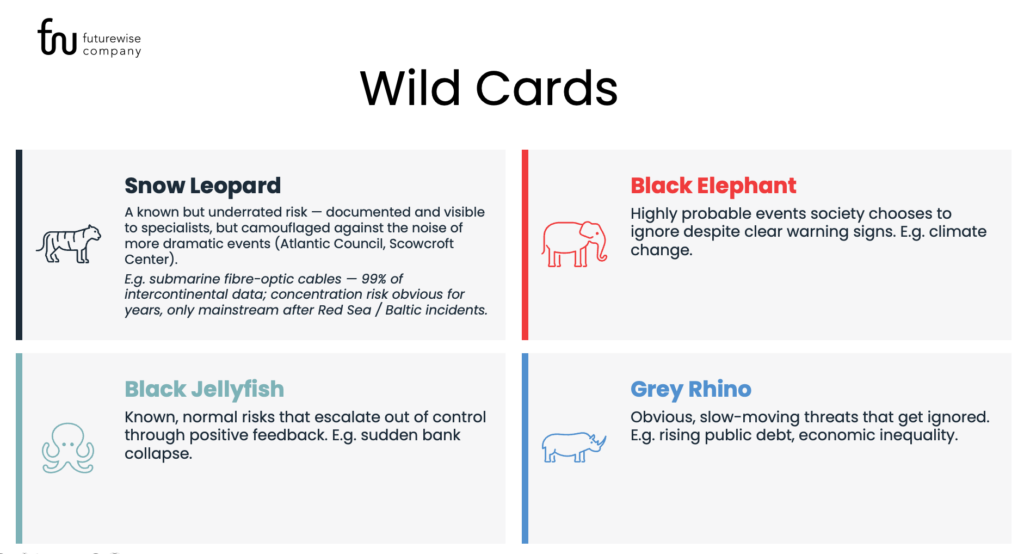
The Four Animals in the Foresight Bestiary

Snow Leopard

A known but underrated phenomenon: documented and visible to specialists, but camouflaged against the noise of more dramatic events and therefore systematically underweighted. The metaphor was developed by the Atlantic Council’s Scowcroft Center for its Global Foresight reports, named for the species’ disruptive coat pattern that breaks up its outline against Himalayan terrain — the ghost of the mountains. (Some risk-management writers use white leopard for the same idea.)

Example: the vulnerability of submarine fibre-optic cables, which carry roughly 99 percent of intercontinental data and a significant share of global financial settlements. The concentration risk has been documented for years; it took incidents in the Red Sea, the Baltic, and the Taiwan Strait to bring it into mainstream view.

Black Elephant

A high-probability, high-impact event that is already documented and discussed by specialists, but that society chooses to treat as unlikely because acknowledging it would demand uncomfortable change. The term was coined in 2009 by disaster-relief consultant Vinay Gupta and popularized in 2014 by environmentalist Adam Sweidan through Thomas Friedman’s New York Times column. When the elephant finally arrives, it gets relabelled a black swan that nobody could have seen coming.

Example: anthropogenic climate change. The physics has been understood since Arrhenius’s 1896 calculations, the projection literature is consistent across IPCC cycles, and the response has nevertheless behaved as though the problem belongs to a future generation.

Black Jellyfish

A known, ostensibly normal phenomenon that escalates into systemic crisis through positive feedback — a small input that, amplified by interconnected systems, produces effects out of all proportion to its starting scale. The term comes from Ziauddin Sardar’s postnormal times theory and represents “unknown knowns”: phenomena we believe we understand but whose behaviour at scale surprises us.

Example: the 2013 shutdown of Sweden’s Oskarshamn nuclear plant, when Aurelia aurita blooms — driven by warming seas, ocean acidification, and overfishing of jellyfish predators — clogged the cooling intakes and forced a 1,400-megawatt reactor offline.

Grey Rhino

A high-probability, high-impact threat that is large, visible, slow-moving, and consistently ignored despite a complete absence of any information deficit. Introduced by policy analyst Michele Wucker in her 2013 World Economic Forum address and developed in her 2016 book The Gray Rhino. Wucker’s point, against the prevailing fashion for black swan vocabulary, is that most major crises are not surprises at all; the interesting question is why the institutions in their path failed to move.

Example: the 2008 subprime crisis. Shiller’s Irrational Exuberance documented the housing bubble in 2005, the Bank for International Settlements flagged systemic risk in 2006 and 2007, and the FBI warned of a mortgage-fraud “epidemic” as early as 2004. The rhino was visible from a considerable distance.


The point of wild card thinking isn’t prediction; it’s the cultivation of adaptive capacity, in the same sense biologists and resilience engineers use the term. An organization that has seriously rehearsed the loss of its largest supplier tends to handle the loss of its second-largest one with more composure, even though the specific scenario was wrong, because the underlying flexibility transfers. Beyond that, sitting with the improbable for any length of time tends to bring back into the strategy conversation a set of unfashionable virtues — redundancy, optionality, slack, balance sheet conservatism — that long periods of stability quietly erode, and whose absence is universally regretted in the first quarter after stability ends.

So what does all of this leave us with, after the dust of the past few years has settled and “black swan” has gone the way of most overused phrases? Mostly a sharper vocabulary, and a slightly more honest one. The wild cards, the elephants, the jellyfish, the leopards, the rhinos — these aren’t predictions and were never meant to be. They are a way of naming the different ways the future tends to escape the assumptions we’ve built our planning on, and a reminder that when the next big surprise lands, the interesting question won’t be whether it was foreseeable. It almost always was, by somebody. The interesting question will be whether anyone in the room had been paying attention.

Thinking in Futures: Scenario Development in Foresight

The future never arrives as a single, predictable line. This is why strategic foresight has largely abandoned the idea of “predicting” what comes next in favor of something far more useful: developing scenarios – multiple, plausible, internally consistent stories about how the future could unfold.

Scenario development is not about being right, but about being prepared. It helps organizations stretch their imagination, stress-test their strategies, and recognize the early signals of change before competitors do. Below, we’ll walk through what scenario development is, why it matters, and three of the most influential approaches practitioners use today: the Shell scenario method, the 2×2 matrix, and the archetypes approach.

Why Scenarios?

Traditional forecasting extrapolates from the present: take last year’s numbers, adjust for known trends, and project forward. This works reasonably well in stable environments. It fails spectacularly when the world shifts — during pandemics, geopolitical ruptures, technological leaps, or financial crises.

Scenarios are not about the question: “what is most likely?”, but about “what is possible, and what would each possibility mean for us?” A good set of scenarios captures the genuine uncertainty of the future without dissolving into infinite possibilities. They are tools for decision-making under deep uncertainty, helping leaders see their assumptions, identify blind spots, and build strategies robust across multiple futures.

There are dozens of ways to develop scenarios, so here are the most interesting ones:

The Shell Scenario Approach

No discussion of scenario planning is complete without Royal Dutch Shell. In the late 1960s and early 1970s, Shell’s planners – most famously Pierre Wack – pioneered a method that would become legendary after the company anticipated the 1973 oil crisis when its competitors did not.

The Shell approach is intensive, narrative-driven, and deeply qualitative. It typically begins with framing a strategic question — something concrete enough to matter but broad enough to invite real exploration. From there, planners scan the environment for driving forces: technological, economic, environmental, political, and social factors that shape the issue. These forces are then sorted by importance and uncertainty, and the most critical uncertainties become the backbone of two to four richly developed scenarios.

What makes the Shell method distinctive is its emphasis on storytelling and challenge. Scenarios are not bullet-point lists of conditions; they are coherent, plausible narratives with internal logic, vivid detail, and named characters of change. The goal is to produce stories that surprise executives, force them to confront mental models, and leave a lasting impression. Shell still publishes major scenario studies today, often with multi-decade time horizons exploring energy transitions and geopolitical shifts. The strength of the Shell approach is depth. Its weakness is cost: doing it well takes months of work, skilled facilitators, and senior leadership engagement.

The 2×2 Matrix Method

If the Shell approach is the gold standard, the 2×2 matrix is the workhorse. Developed and popularized by the Global Business Network (GBN) in the 1990s — drawing heavily on Shell’s intellectual heritage — it offers a faster, more accessible way to generate four scenarios that span a meaningful range of futures.

The method is elegant in its simplicity. After identifying the driving forces relevant to the question at hand, the team selects the two most important and most uncertain forces. These become the axes of a matrix. Each axis runs from one extreme to the other (for example, “high regulation” to “low regulation”), and the four resulting quadrants each describe a distinct future world.

Imagine a company exploring the future of urban mobility. The team might land on two critical uncertainties: the pace of autonomous vehicle adoption (slow vs. fast) and the dominant ownership model (private vs. shared). The four quadrants then yield four very different futures — a world of privately owned self-driving cars, a world of shared autonomous fleets, a world of traditional private ownership, and a world of shared human-driven mobility. Each quadrant gets a name, a narrative, and a set of implications for strategy.

The 2×2 method is widely loved because it is fast, visually intuitive, and produces scenarios that feel meaningfully different. It works well in workshops and is easy to communicate to stakeholders. The trade-off: by collapsing complexity into two axes, it can oversimplify, and the choice of axes carries enormous weight. Pick the wrong two uncertainties and you get four scenarios that feel hollow.

The Archetypes Approach

The archetypes method takes a different starting point. Rather than building scenarios from the ground up via driving forces, it draws on the observation — first made systematically by futurist Jim Dator and developed further by researchers like Sohail Inayatullah and Peter Bishop — that scenario stories tend to cluster around a small number of recurring patterns. Dator’s classic four archetypes are:

Continued Growth — the future as more of the present, with established trends extending forward. Economies expand, technology progresses, institutions persist.

Collapse — systems break down. Environmental, economic, political, or social crises overwhelm existing structures, leading to significant decline or rupture.

Discipline — society organizes around a constraining principle, often in response to limits. Resources, behaviors, or freedoms are deliberately constrained to preserve something deemed essential — sustainability, security, tradition, equality.

Transformation — a fundamental shift in what it means to be human or to organize society, typically driven by technological, spiritual, or values-based change. The post-transformation world operates by different rules entirely.

Practitioners take their core question and write each archetype into a scenario specific to the topic. A study of the future of higher education, for example, would produce a “continued growth” scenario where universities keep expanding, a “collapse” scenario where the model breaks under financial and demographic pressure, a “discipline” scenario where education is reorganized around tighter purposes and constraints, and a “transformation” scenario where AI, biotechnology, or new social structures redefine learning entirely. The archetypes approach is powerful because it forces teams to consider futures they might otherwise avoid — particularly collapse and transformation, which executives often find uncomfortable. It also produces scenarios that span a genuinely wide possibility space. Its limitation is that the archetypes can feel formulaic if applied mechanically, and they sometimes obscure the specific driving forces shaping a particular issue.

Our Approach at the Futurewise Company

At Futurewise, we don’t believe in one-size-fits-all foresight. Every strategic question carries its own texture — different uncertainties, different stakeholders, different time horizons — and our methodology adapts accordingly. While we draw on the established traditions described above, we typically build scenarios through a tailored sequence that combines several techniques into a coherent process.

We often begin with the Futures Wheel, a structured ideation tool that helps us trace the ripple effects of a change. Starting from a central trigger — a new technology, a regulatory shift, a demographic transition — we map out first-order consequences, then second- and third-order effects radiating outward. This is particularly powerful for surfacing emerging customer needs or identifying problems that haven’t yet appeared on anyone’s radar. If autonomous delivery becomes mainstream, what new anxieties, opportunities, or behaviors does that create two or three steps down the line? The Futures Wheel makes the implicit explicit.

Once we’ve identified emerging needs or problems, we ask the critical follow-up question: under what conditions would these actually emerge? A trend identified in a workshop is not the same as a trend that will materialize in the world. We systematically define the conditions that would have to hold — regulatory environments, technological maturity, consumer trust, infrastructure readiness, geopolitical stability — for each potential development to take shape.

These conditions are then assessed through an impact/uncertainty matrix. Each condition is plotted on two dimensions: how much it would shape the outcome if it occurred (impact), and how unpredictable its trajectory is (uncertainty). The conditions that cluster in the high-impact, high-uncertainty corner become our candidates for scenario axes — because these are precisely the factors where being wrong matters most and where the future genuinely could break in different directions.

From this assessment, we select the most strategically critical uncertainties as our axes and build out scenarios. To pressure-test and enrich these scenarios, we draw on an adapted Delphi Method. The classical Delphi approach gathers expert input through anonymous multi-round surveys until consensus emerges, but we’ve reshaped it to fit the realities of strategic work with executives. Instead of running surveys, we conduct semi-structured 1:1 interviews built around hypotheses derived from our earlier foresight work — the Futures Wheels, the impact/uncertainty assessments, the draft scenario matrices. This format preserves the comparability across experts that makes Delphi valuable, while allowing for the depth, nuance, and unexpected insights that only a real conversation can surface. We then synthesize these expert perspectives to sharpen our scenarios, identify future growth opportunities, and build decision-relevant views on the strategic risks and opportunities our clients face.

Choosing an Approach

These three methods are not in competition. Experienced practitioners often combine them, using the Shell method’s rigor for high-stakes long-term studies, the 2×2 matrix for workshops and rapid strategy sessions, and the archetypes for ensuring breadth of imagination. The right choice depends on the question, the time available, and the audience.

What unites all three is a fundamental commitment: take the future seriously as a space of multiple possibilities, build coherent stories about those possibilities, and use them to make better decisions today. Done well, scenario development does not eliminate uncertainty — it equips you to act wisely within it.

The future will still surprise you. But with good scenarios, fewer of those surprises will be the kind that catch you completely off guard.

The Delphi Method in Foresight - and How We Use It

Originally developed at the RAND Corporation in the 1950s, the Delphi method is a structured way to gather and synthesize expert opinion on questions about the future – particularly where data is scarce and uncertainty is high. It is a multi-stage, survey-based approach used in foresight, typically designed to arrive at a stable assessment through controlled feedback across several rounds, while avoiding the influence of dominant individuals.

In foresight, Delphi is less about asking open questions and more about testing sharply formulated hypotheses about how the future might unfold. It allows us to systematically confront these hypotheses with diverse expert perspectives – across hierarchies, geographies, and sectors – and to understand not only where views converge, but where they meaningfully diverge. The goal is not a single prediction, but a clearer map of plausible futures, underlying assumptions, and critical uncertainties.

At the Futurewise Company, we have adapted the method to fit strategic work with executives. Instead of anonymous multi-round surveys, we run Delphi as semi-structured 1:1 interviews based on hypotheses derived from earlier foresight tools such as Futures Wheels or scenario matrices. This approach preserves comparability across interviews while allowing for depth, nuance, and unexpected insights. We then synthesize these expert perspectives to refine scenarios, explore future growth opportunities, and build decision-relevant views on strategic risks and opportunities.

Starting With Hypotheses

Before we ever talk to an expert, we need to know what we are actually trying to learn. That foundation comes from earlier foresight work — typically a Futures Wheel, a 2×2 scenario matrix, or both.

These tools generate something useful: a map of the drivers, dependencies, and fields that matter for our research question. From that map, we extract two things. First, the topical territory we need to cover. Second, the conditions that are simultaneously high impact and high uncertainty — the places where the future is genuinely unsettled and where expert input will move our thinking the most.

This, for how we conduct Delphi interviews at the Futurewise Company, is the raw material for hypothesis formulation.

A hypothesis like “manufacturing will change in Germany” is useless. Nobody will disagree with it, and nobody will say anything interesting in response. Compare it to: “In 2036, most manufacturing and production will be outsourced. What remains in Germany is R&D only.”

That version is specific. It commits to a timeframe, a geography, and a structural claim. It is also slightly provocative — and that is intentional. Vague hypotheses get vague answers. Provocative hypotheses force experts to either defend or dismantle the claim, and either response gives you signal.

The rule we follow: be specific, and lean toward the provocative end. If your hypothesis could be the headline of a contrarian opinion piece, you are probably in the right zone.

Choosing the Right Experts

Once the hypotheses are sharp, we work backwards from them to figure out who needs to weigh in. A good Delphi panel is not just “smart people we can reach.” It is a deliberately structured group designed to surface different angles on the same question.

We think about diversity along several axes:

  • Hierarchy. Strategic voices (C-suite, policy leads) see the system. Operational voices (engineers, plant managers, frontline analysts) see the friction. Both are necessary, and they often disagree in productive ways.
  • Geography. A question about German manufacturing looks different from Munich, Shenzhen, and Detroit.
  • Organizational background. We aim for a mix across academia, government, media, industry, civil society, think tanks, and consultancies. Each sector carries its own incentives and blind spots, and the contrast is where insight lives.

The goal is not balance for its own sake. It is to make sure that when consensus does emerge, it is meaningful – and when disagreement emerges, we know exactly which fault lines are doing the work.

Finding and Reaching Experts

The hardest part is often just getting people to talk to you. A few channels work consistently for us:

LinkedIn is the obvious starting point, but the higher-yield move is browsing speaker lists from relevant conferences. People who agree to speak publicly on a topic are, by definition, experts in their field and willing to talk about it — a rarer combination than it sounds.

Internal networks are underrated. Your CEO, your shareholders, and your sales team often have networks that took decades to build. Use them. A warm introduction from them beats a cold message every time.

Beyond that: scientists who have published recently in the area, VCs investing in the space (they have done their own diligence and are usually happy to share a slice of it), and journalists covering the beat. Journalists in particular tend to know a lot of people and have a strong sense of who is worth listening to versus who is just loud.

Designing the Questions

Generic questions produce generic answers. The framing techniques below are designed to get experts out of their default talking points and into more useful territory.

Post-mortem questions project the panelist into a future where something has already happened, and ask them to explain it. “It is 2036, and Germany has lost its position as a manufacturing hub. What were the three decisions in the 2020s that caused this?” This bypasses the natural tendency to hedge and forces a causal narrative.

Best-case scenario questions do the inverse. “Imagine the optimistic version of 2036 for German industry. What does it look like, and what had to go right?” Useful for surfacing what experts secretly hope for, which is often a better signal than what they predict.

Lived-reality questions ground the abstract in the concrete. “You wake up in 2036 and walk into a production site. What has changed since 2026?” Sensory, specific framing pulls people away from buzzwords and toward detail.

Counterfactual futures stress-test dependencies. “If Person X had not remained in office after 2028, what would have shifted in the years that followed?” This exposes which assumptions in an expert’s worldview are actually load-bearing — and which are just decoration.

Running the Interviews

In our case, we run the panel as semi-structured 1:1 interviews. Fully structured interviews are too rigid; you miss the digressions where the real insight often lives. Fully unstructured ones make cross-comparison impossible. Semi-structured is the sweet spot.

We build a question guideline organized around the hypotheses, clustered by theme. Not every expert gets every question — a regulatory scholar and a factory floor manager have different things to offer, and forcing them through identical scripts wastes everyone’s time. But within each cluster, we keep enough overlap across panelists that we can compare answers meaningfully later.

Every interview is recorded and transcribed. This is non-negotiable. Memory distorts, and the analysis phase depends on having the actual words.

Analyzing What You Heard

The analysis is essentially a search for two patterns: similarity and difference.

Where do experts converge? Convergence across a diverse panel — different sectors, hierarchies, geographies — is a strong signal. It does not mean they are right, but it means a particular view of the future is widely held by people who have thought hard about it. That is worth knowing, and worth challenging.

Where do they diverge? This is usually the more interesting finding. Sharp disagreement often maps onto the high-uncertainty zones we identified at the start, and the shape of the disagreement matters. Are the academics aligned against the industry voices? Are the strategists split from the operators? Is it a regional pattern? Each of these tells you something different about what the real fault lines in your topic actually are.

Our recommendation: Read between the lines: sometimes the most important things get mentioned in passing – a throwaway aside, a half-finished thought – and AI-driven analysis tends to miss exactly those moments, so during the interview take notes, especially on the minor mentions that feel quietly major.

The output of a Delphi round is rarely a clean answer. It is a more textured map: clearer on which futures have broad expert backing, clearer on which ones are genuinely contested, and clearer on what would have to change for one trajectory to win out over another.

Why Delphi?

Delphi works because it does something neither pure data analysis nor pure intuition can do on its own. It systematically harvests tacit knowledge — the kind that lives in the heads of people who have spent careers in a field — and structures it well enough that you can compare, contrast, and act on it.

What Is a Futures Wheel?

A simple tool to think complex thoughts about the future

The Futures Wheel is one of those rare foresight tools that looks deceptively simple — and then quietly forces you to confront how non-linear the future really is.

Originally developed in 1971 by Jerome C. Glenn, the Futures Wheel has guided futurists, strategists, and decision-makers for more than five decades in exploring the ripple effects of change. It is also documented in the Futures Research Methodology (FRM), one of the core reference works in professional foresight.

At its core, the Futures Wheel helps individuals and organizations move beyond linear cause-and-effect thinking, and instead map how one change can cascade across systems, sectors, and societies.

The basic idea

A Futures Wheel is a structured, visual brainstorming method used in strategic foresight to explore the direct and indirect consequences of a specific trend, event, decision, or innovation.

It asks:

“And then what?”
“And what follows from that?”
“Who else is affected, and how?”

The result looks a bit like a spider web or a set of concentric circles — but conceptually, it represents chains of impact spreading outward over time.

How a Futures Wheel is structured

The structure is deliberately simple:

1. The center: the change

At the core sits a single, clearly defined change, often phrased as a thesis:

  • A new technology
  • A regulatory shift
  • A strategic decision
  • A societal or economic trend

Example: “Autonomous trucks become mainstream in Europe.”

2. First-order consequences

In the first ring around the center, you map direct, immediate effects — the things that happen because the change occurs.

These are often the most obvious impacts.

3. Second- and third-order consequences

From each first-order consequence, you then ask: “What does this lead to?”

These indirect effects populate the outer rings:

  • Effects of effects
  • Side effects
  • Feedback loops
  • Unintended consequences

What problem does the Futures Wheel solve?

Most strategic thinking fails in one of two ways:

  • It stays too linear (“If X happens, Y follows”).
  • It focuses only on first-order effects, missing the real strategic implications.

The Futures Wheel is designed to do the opposite. Its purpose is to:

  • Surface complex, interconnected consequences
  • Reveal unexpected risks and opportunities
  • Challenge optimistic or pessimistic single-story futures
  • Make implicit assumptions visible

In short: it helps teams think systemically about change.

Where and how it is used

The Futures Wheel is widely applied across contexts, including:

  • Strategy & innovation: exploring second-order effects of new products or business models
  • Technology foresight: assessing societal, economic, and regulatory impacts of emerging tech
  • Policy & regulation: anticipating unintended consequences of laws or reforms
  • Organizational decision-making: stress-testing major strategic moves

It is especially useful early in a foresight or strategy process, before numbers, roadmaps, or KPIs narrow the field of vision.

What is a driver? What is a trend?

Drivers: a definition

Drivers are the causes behind a trend. They describe the fundamental forces that set change in motion or accelerate it. A driver is an underlying dynamic that enables, forces or structures change.

Typical characteristics:

  • often operate over the long term
  • are frequently structural or systemic
  • aren’t always directly visible
  • can usually be assigned to a STEEP category

Examples

  • Demographic change
  • Technological progress (AI and automation, for instance)
  • Climate change
  • Geopolitical shifts in power
  • Changing values (security versus freedom, for instance)

 Drivers answer the question: “Why is something changing?”

Trends: a definition

Trends are the visible expressions of change.
They describe concrete developments, stable over a certain period, that emerge from one or more drivers.
A trend is an observable pattern in behavior, markets, technologies or social practice.

Typical characteristics:

  • are visible and can be described concretely
  • develop over a limited period (and can gain or lose momentum)
  • can be illustrated with examples, data or narratives
  • usually emerge from the interplay of several drivers

Examples

  • Remote and hybrid work
  • Electric mobility
  • Personalized medicine
  • The circular economy
  • Subscription models replacing ownership

Trends answer the question: “How does change actually show up?”