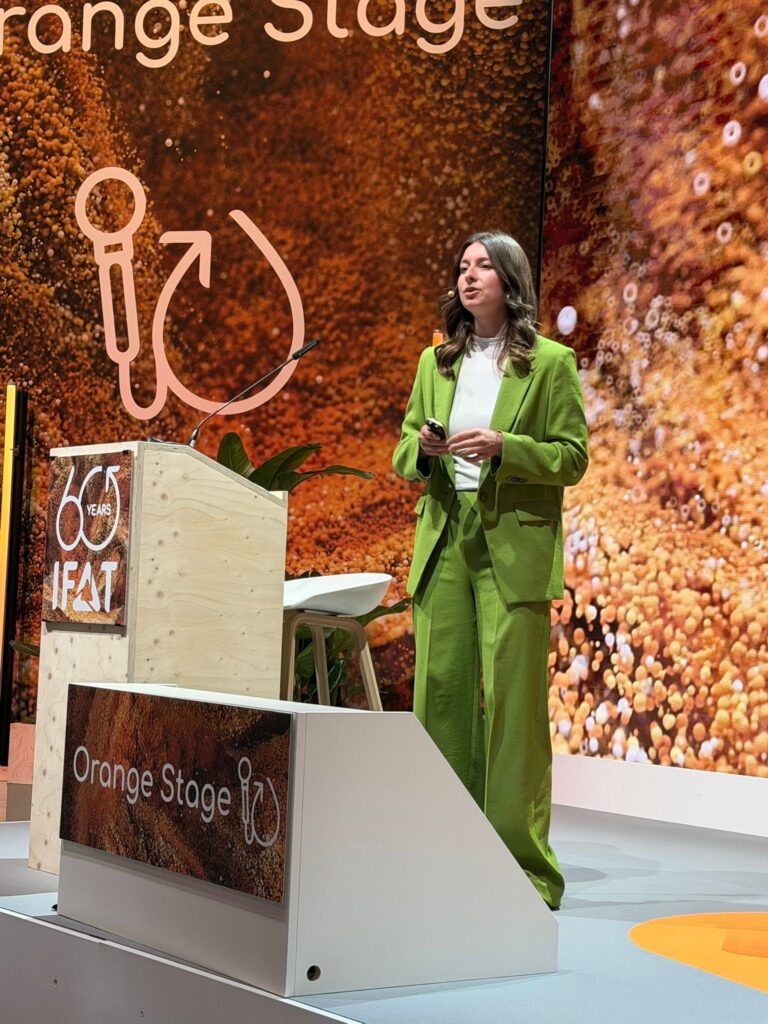
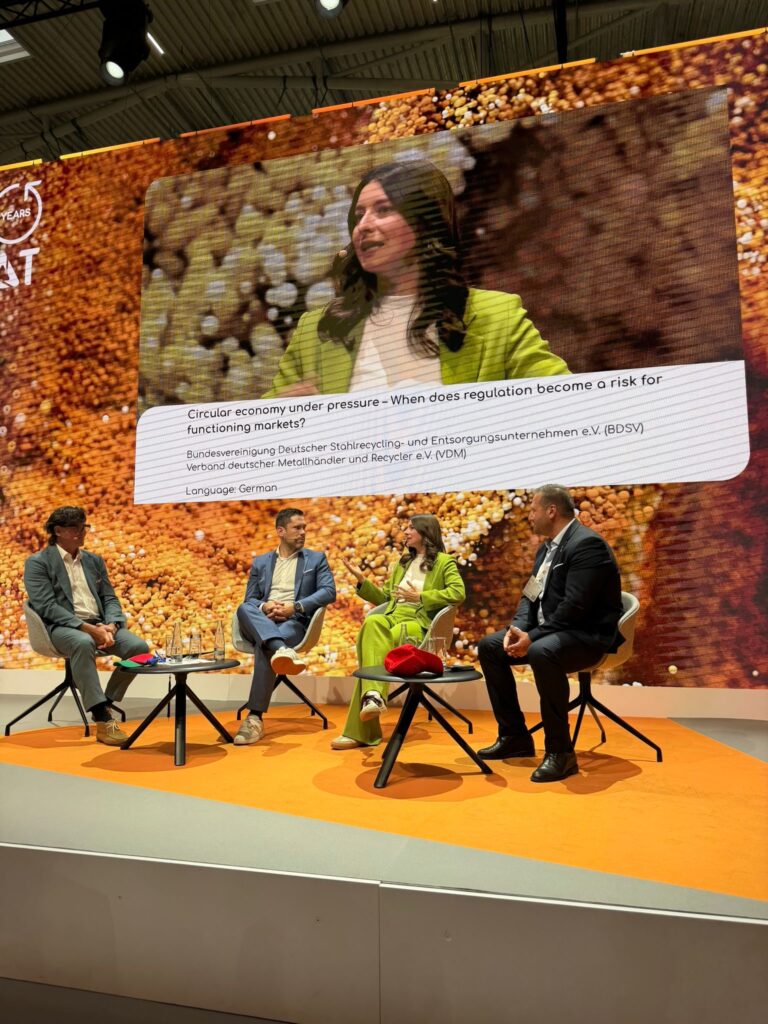
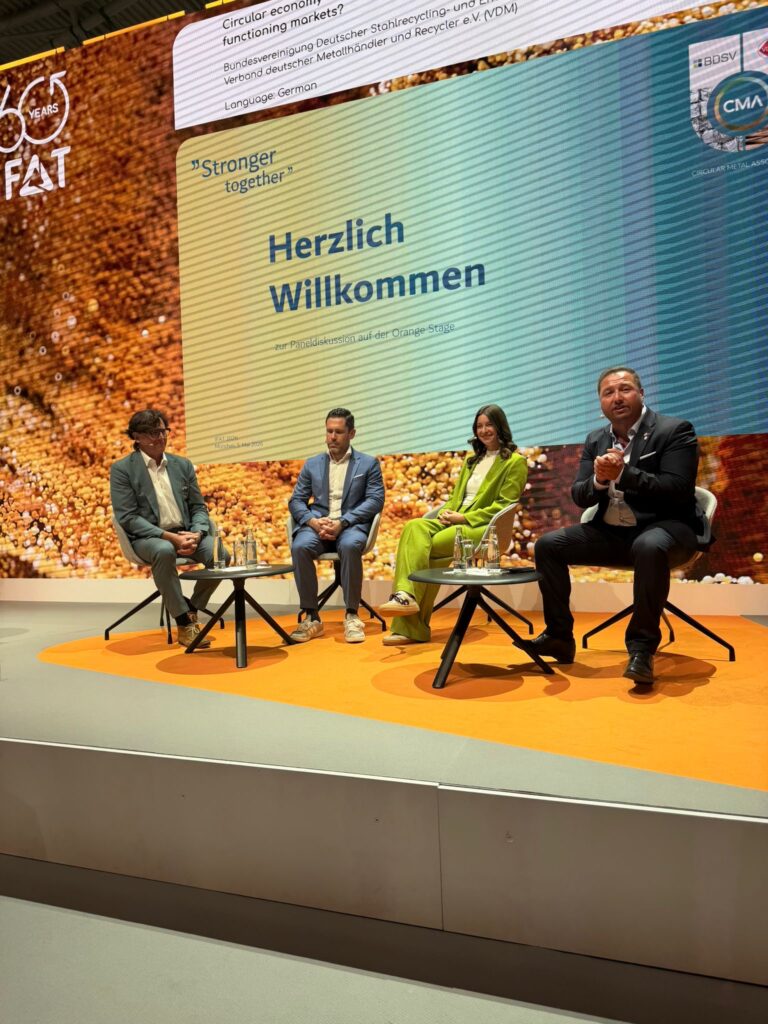
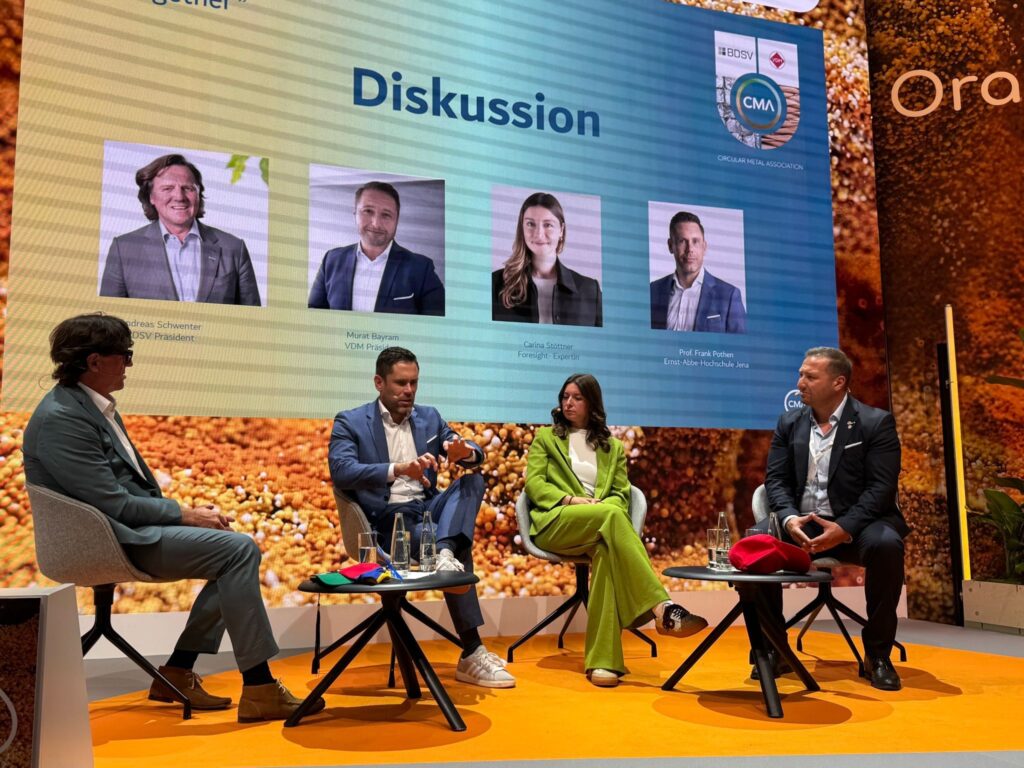
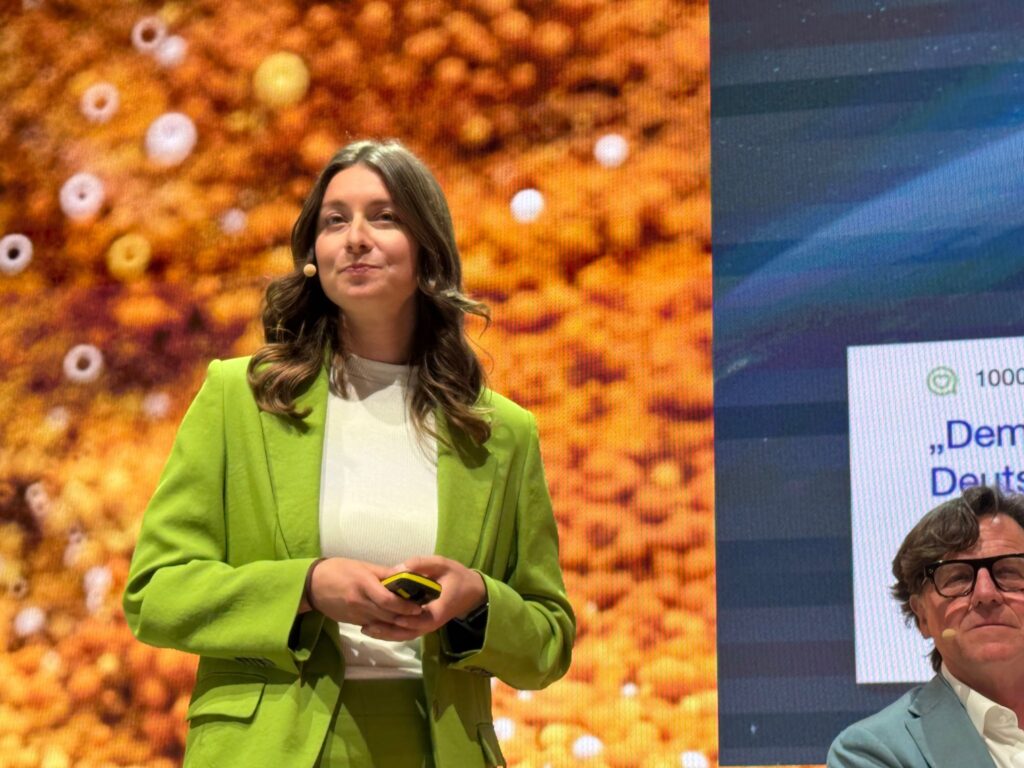
Carina Stöttner as a speaker at IFAT for the steel and metal recycling industry

Munich, IFAT 2026 – the world’s leading trade fair for environmental technologies. On stage sit four people negotiating together a question that could hardly be more decisive for Europe’s industrial future: Where is the circular economy heading – toward a highly technologized, globally integrated system? Or are protectionism and geopolitical fragmentation pulling it back from the international stage?

The hosts were the BDSV (German Federation of Steel Recycling and Disposal Companies) and the VDM (Association of German Metal Traders and Recyclers) – two associations that are currently merging into the future Circular Metal Association. On the panel: Murat Bayram, Andreas Schwenter, Prof. Dr. Frank Pothen – and futures researcher Carina Stöttner, whose short keynote set out the framework for the discussion.

What became visible in the process goes far beyond the industry: steel and metal recycling is one of the places where it is decided whether Europe remains industrially sovereign – and whether it does so in a way that is fit for the future.

The underrated industry: What has long existed

Before talking about the future, it is worth looking at the present. In Germany alone, around 10,000 circular economy companies account for about 300,000 jobs. In Europe, the figure runs to several million jobs. Family-run small and medium-sized enterprises, specialized plant manufacturers, highly technologized sorting operations – over the past decades they have invested billions in shredding plants, modern processing technology, and AI-supported sorting.

Murat Bayram’s message on the panel was therefore clear: This industry must stop talking itself down. Recycling operations are not a burden on the environment but, in the words of Andreas Schwenter, environmental protection facilities. They secure raw materials, avoid CO₂, enable green steel, and lay the foundation for industrial value creation in Europe.

Prof. Dr. Frank Pothen provided the economic underpinning: every ton of recycled steel scrap avoids considerable CO₂ emissions. The circular economy is not an accessory to climate policy, but its practical core.

Into this self-understanding Carina Stöttner placed her impulse – and opened up the view ahead.
Stöttner’s scenarios: possible futures for the circular economy

Stöttner’s opening question in the keynote was pointed: Where is our industrial economy heading? And what does that mean for the steel, metal, and recycling industry?

  • Scenario A – High-tech circular economy. A globally integrated circular economy in which AI sorting, robotics, new materials sciences, digital material passports, and international cooperation work together. Recycling rates rise drastically, the quality of secondary raw materials reaches primary level, and Europe becomes the technology leader in a growth market.
  • Scenario B – customers migrate away and relocate production largely abroad. And with them go raw materials in the form of production scrap, as well as the demand for recycled materials.
  • Scenario C – fragmented protective economy. Rising protectionism, new export bans, regional isolation. The industry loses economies of scale, investment power, and innovation pressure. The circular economy does become necessary, but does not turn into a global growth field.

Her message: Which scenario comes to pass is not a forecast. It is a decision. And this decision is being made right now – in Brussels, in Berlin, in supervisory boards, in investment committees.

Deeptech as the future formula of the circular economy

What Stöttner made particularly clear at IFAT: The next stage of the circular economy is a deeptech stage.

In concrete terms, that means:

  • AI-supported sorting and material identification, delivering secondary raw materials in qualities that today only primary raw materials achieve
  • Robotics in the dismantling of complex products – from electric cars and wind turbines to electronics
  • New materials and processes that orient product design toward circularity from the very outset
  • International cooperation in research, standards, and trade, because no single market is large enough to bear these investments alone

The trade-off: When protection weakens the very industry it is meant to protect

It was precisely at this point that Stöttner’s keynote interlocked with the pointed position of the associations on the panel. Andreas Schwenter and Murat Bayram were unequivocal on one matter: Protectionism, export bans, and additional trade barriers are not a future strategy.

The logic behind this is not ideological, but rooted in industrial reality:

  • Those who seal off markets deprive the industry of investment power. Recycling technology scales only with global sales markets – not with national residual volumes.
  • Those who restrict scrap exports slow innovation. International competition is precisely what has made the German recycling industry into the leading position it holds today.
  • Those who bet on self-sufficiency lose quality. Secondary raw materials require specialization, sorting purity, and international material flows. Closed systems produce lower qualities at higher prices.
  • Those who overload the Mittelstand with bureaucracy weaken the backbone of the circular economy. The ten thousand companies that carry the system need framework conditions that enable – not hold back.

That does not mean: no sovereignty. It means: smart sovereignty instead of a protective-wall reflex. Strategic reserves, diversification of critical material flows, European standards – yes. Long-term, blanket export bans and new walls – no.

Stöttner’s contribution to this: An industry that hunkers down gains short-term security and loses long-term future. The desirable circular economy is open, cooperative, and technologically ambitious – not defensive.

What the industry needs now: less nostalgia, more courage

From the panel and Stöttner’s keynote, four imperatives for the coming years could be distilled – not as finished answers, but as the right questions:

  1. Self-confidence instead of justification mode. For decades, the industry has been solving in practice what others demand in theory. This achievement belongs in the public narrative about climate protection and industrial sovereignty.
  2. Deeptech investments now. AI, robotics, new materials, and digital traceability are no longer pilot projects. They are the foundational technologies of the sector for the next twenty years.
  3. Framework conditions that enable. Reducing bureaucracy, faster approval procedures, reliable energy and trade policy – so that investments can take place in Europe rather than elsewhere.
  4. International cooperation as a strategy. European strength does not arise from going it alone, but in alliance with global partners, shared standards, and open markets – while maintaining sovereignty in genuine key areas.

The announced merger of BDSV and VDM into the Circular Metal Association fits precisely into this line: more clout, more unity, more future – and an industry that is finally positioning itself the way it has long been set up.

Conclusion: The future of the circular economy can be shaped

Stöttner’s central message at IFAT: The future is not predetermined. It can be shaped.

Whether Europe builds a global high-tech circular economy or retreats into a fragmented protective economy will not be decided in forecasts. It will be decided in the next rounds of investment, in the next wave of European regulation, in the question of whether the industry takes its own strength seriously – and whether politics has the courage to open up spaces of possibility rather than close them.

About the event

The IFAT in Munich is the world’s leading trade fair for water, wastewater, waste, and raw materials management. On the joint stage format of BDSV and VDM – the associations of the steel and metal recycling industry that are merging into the Circular Metal Association – the following took part in the discussion:

  • Carina Stöttner, futures researcher, CEO futurewise company
  • Murat Bayram, President, VDM
  • Andreas Schwenter, President, BDSV
  • Prof. Dr. Frank Pothen, Professor of economics at the University of Applied Sciences (Ernst-Abbe-Hochschule) in Jena

Offsite: Why executive boards, executives, and teams need a change of scenery

When the calendar is overflowing, the strategy is talked to death between two quarterly reports, and no one knows anymore what the team is actually working on – then it’s time for an offsite. But what lies behind the term that, in corporations and start-ups alike, is increasingly becoming a fixed part of leadership work?

Offsite meaning: More than just a change of scenery

The literal translation of offsite into German is simply “away from the location.” But the meaning of offsite goes far beyond the geographical aspect. An offsite is a planned work event outside the usual office environment that creates space for strategic thinking, intensive collaboration, and undisturbed reflection.

In contrast to the classic meeting in the conference room, an offsite event pursues three central goals:

  • Distance from day-to-day business, in order to sharpen the view of the big picture
  • Concentrated working time for strategic matters without interruptions from operational topics
  • Strengthening of relationships among the participants

While the term has long been established in English, offsite in German is increasingly catching on in business language – as a synonym for closed-session conference, strategy workshop, or leadership retreat.

The various formats: From the team offsite to the shareholder offsite

Not every offsite is the same. Depending on the group of participants and the objective, different formats have become established.

Team offsite

The team offsite is aimed at working groups, departments, or project teams. The focus here is on operational planning, team culture, and solving concrete challenges. Typical topics are quarterly planning, retrospectives, onboarding new team members, or the development of shared ways of working.

Company offsite

company offsite encompasses the entire workforce or at least large parts of it. Such formats often have an event character and combine work phases with shared experiences. They are particularly suited to conveying company values, making strategies transparent, and strengthening the sense of togetherness – an aspect that is becoming ever more important in times of distributed teams and hybrid work.

Executive board offsite and board meeting offsite

The offsite for the executive board is the premier format of strategic closed sessions. Here, the management, board members, or C-level come together to work on fundamental questions away from operational pressure: Where does the company stand? Where is the market heading? Which strategic course must be set now?

board meeting offsite goes beyond the formal session. While regular board meetings are often dominated by mandatory topics, reportings, and resolutions, the offsite format creates space for more in-depth discussions about future themes, risks, and opportunities.

Shareholder offsite

The shareholder offsite brings together shareholders, investors, and management. Such meetings serve the strategic exchange about the long-term direction of the company, upcoming investment decisions, or the assessment of business development. In contrast to the annual general meeting, the focus here is on confidential, dialogue-based exchange.

Why classic offsite meetings often fail

Despite good intentions, many offsite meetings turn out disappointing. The most common causes can be traced back to a few patterns.

For one thing, the preparation is underestimated. An offsite is not a change of scenery with random discussions, but requires a clear agenda, a well-thought-out methodology, and defined outcome goals. For another, neutral facilitation is often lacking. When the management facilitates and joins the discussion on substance at the same time, both roles suffer. Important voices go unheard, conflicts are swept under the rug, decisions are postponed.

Another problem: the lack of follow-up. What was decided at the offsite peters out in day-to-day business if no consistent implementation follows.

What makes a good offsite

Successful offsites are characterized by a few central features. They have a clear focus rather than an overloaded agenda – better to truly penetrate two topics than to skim over ten superficially. They make use of the right environment, because the place shapes thinking: an inspiring venue opens up different mental spaces than the conference room at headquarters.

Good offsites work with professional facilitation that guides through complex discussions, involves all voices, and also puts uncomfortable topics on the table. They combine work and recovery in a dramaturgy that interlocks phases of concentration with informal encounters, movement, and reflection time. And they end with concrete results: defined measures, responsibilities, and timelines.

Strategic topics for executive board offsites

At the executive board level in particular, certain thematic fields have proven especially valuable for offsite formats.

Future strategy: How does the company position itself over the next five to ten years? Which technological, regulatory, and societal developments will shape the business model? Such questions need time, space, and a protected setting.

Scenario planning: Instead of linear forecasts, executive boards develop alternative images of the future at offsites. What happens if the economy slumps? If a new competitor shakes up the market? If regulatory requirements change fundamentally? Thinking in scenarios makes the company more resilient.

Sharpening the customer view: In the operational everyday, leaders often lose their direct line to customers. An offsite can bring this view back into focus – through customer journey analyses, persona work, or direct exchange with selected customers.

Organizational development: Phases of growth, crises, or strategic realignments raise the question of whether the organization still fits the strategy. Executive board offsites offer the setting to fundamentally question structures, processes, and leadership models.

The underrated factor: External facilitation

Anyone planning an offsite at the executive board level or in the extended leadership circle should not underestimate one aspect: the facilitation. External, professional facilitation brings several advantages. It is neutral, has no political interests within the company, and can also ask the difficult questions that no one internally dares to voice. It structures discussions with proven methods, ensures the participation of everyone present, and captures results in such a way that they become actionable.

Especially with strategically highly relevant topics such as future strategy or scenario planning, this investment pays off. The difference between a well-facilitated and a poorly facilitated executive board offsite can amount to several million euros – in wrongly set priorities, missed opportunities, or delayed decisions.

Conclusion: The offsite as a strategic instrument

An offsite is not a luxury, but a strategic tool. Properly conceived and professionally facilitated, it creates clarity where complexity reigns, alignment where silos dominate, and the capacity to act where stagnation looms. Whether as a team offsite, company offsite, executive board closed session, or shareholder offsite – the format unfolds its effect when preparation, facilitation, and follow-up interlock professionally.

The change of scenery alone does not yet make for success. But combined with clear focus, methodological depth, and neutral leadership, the offsite becomes a lever for the most important decisions of your company.

Book offsite facilitation for executive boards and executives

Are you planning an offsite on topics such as future strategy, scenario planning, or the customer view – and would you like it to truly have an impact? Experienced external facilitation ensures that your valuable time at the C-level leads to concrete results.

Arrange a no-obligation conversation now and have your next executive board or executive offsite professionally facilitated.

Jan David Ott and Carina Stöttner are a well-coordinated team when it comes to facilitating your executive board or leadership offsite. Request a no-obligation initial conversation.

Ideas from our foresight work with executives that every leader should know

When we think about the future, our attention goes forward almost automatically: to trends, scenarios, risks and opportunities. But one of the most underrated questions in strategic leadership isn’t what comes next?

It’s this:

What would we have decided differently in the past?

I have little time for simply extending past developments in a straight line into the future. But questioning past decisions — even playing out alternative pasts in your head — is a remarkably effective instrument for making better decisions tomorrow.

Two methods I use regularly in my work with leadership teams:

1. Counterfactual thinking: what if we had decided differently?

Picture a city that handed its best city-center locations to large shopping centers and international chains in the 2010s: H&M, Zara, the usual names.

At the time it looked sensible. Big brands were considered safe. They brought footfall, spending power and reliable tax revenue.

Ten years on, the city center is hollowed out. E-commerce has eaten away at a lot of those store models. Rents stayed high. The cafés, independent shops and local concepts that make a city center feel alive never had a real chance.

The underlying assumption back then was:
large chains are resilient. They draw people in. They’re the future.

But what if the city had decided differently? What could it have done instead, and what would the consequences have been?

That’s where counterfactual thinking earns its keep. The method doesn’t only show what went wrong. It exposes which assumption made the decision feel obvious at the time.

And that’s what makes it strategically relevant today:

Which of our current certainties will look like that empty shopping center in ten years?

2. The pre-mortem: how did it fail?

The second approach is the pre-mortem.

A city is planning its first big marathon. Before any decisions are final, the team asks an unusual question:

Imagine it’s the evening after the event — and it was a failure. What happened?

Suddenly the answers start arriving:

  • Not enough medical staff along the route
  • Road closures were never communicated to residents
  • Aid stations were in the wrong places
  • The start clashed with another major event

None of it was in the original plan. All of it could be fixed in time.

The pre-mortem shifts the perspective. Instead of asking abstractly could this fail?, it asks something more concrete and more useful:

How did it fail?

Imagining failure in advance makes it far more likely you’ll spot the real risks early — before they get expensive.

Why these methods matter for leaders

Strategic work involves a lot of looking forward: market shifts, technological developments, geopolitical scenarios.

But some of the clearest thinking about the future comes from an honest — or hypothetical — look backwards.

Because that’s where you see:

  • which assumptions you’d been treating as facts
  • which risks you systematically underestimated
  • which thinking errors you may well be repeating right now

Being ready for the future isn’t only about looking ahead. It’s also about examining your own certainties.

Willkommen an Bord: Jan David Ott wird Teil der Futurewise Company

Wir freuen uns sehr, Jan David Ott bei der Futurewise Company willkommen zu heißen.

Als Facilitator for Long-Term Strategic Decision-Making & Change begleitet Jan David Aufsichtsräte, Vorstände und Executives dabei, Zukunft nicht nur zu diskutieren, sondern Wandel aktiv zu führen. Sein Fokus liegt auf langfristig tragfähigen Entscheidungen – besonders unter unsicheren Zukunftsbedingungen.

Jan David studierte Jura, Geschichte und Romanistik und verbrachte mehrere Jahre im Ausland – unter anderem in Europa, den USA und dem Nahen Osten. Diese internationale Erfahrung prägt bis heute seinen Blick auf Führung, Transformation und komplexe Entscheidungsprozesse.

Als Geschäftsführer eines Hamburger Callcenters und Leiter des Moskauer Büros des Deutsch-Russischen Forums an der Deutschen Botschaft verbindet er unternehmerische Praxis mit Erfahrung an der Schnittstelle von Wirtschaft, Politik und internationalem Dialog.

Seit 2021 arbeitet er im Bereich Corporate Foresight. Ergänzt wird seine Praxis durch Ausbildungen als interkultureller Mediator sowie als Coach, Trainer und Change Manager.

Mit Jan David stärken wir gezielt unsere Kompetenz in den Bereichen Executive Facilitation, Leadership under Uncertainty und Change. Er bringt die Fähigkeit mit, auch in anspruchsvollen Situationen Klarheit zu schaffen, Perspektiven zusammenzuführen und strategische Bewegung zu ermöglichen.

Willkommen an Bord, Jan David. Wir freuen uns auf die gemeinsame Zukunft.

Thinking in Futures: Scenario Development in Foresight

The future never arrives as a single, predictable line. This is why strategic foresight has largely abandoned the idea of “predicting” what comes next in favor of something far more useful: developing scenarios – multiple, plausible, internally consistent stories about how the future could unfold.

Scenario development is not about being right, but about being prepared. It helps organizations stretch their imagination, stress-test their strategies, and recognize the early signals of change before competitors do. Below, we’ll walk through what scenario development is, why it matters, and three of the most influential approaches practitioners use today: the Shell scenario method, the 2×2 matrix, and the archetypes approach.

Why Scenarios?

Traditional forecasting extrapolates from the present: take last year’s numbers, adjust for known trends, and project forward. This works reasonably well in stable environments. It fails spectacularly when the world shifts — during pandemics, geopolitical ruptures, technological leaps, or financial crises.

Scenarios are not about the question: “what is most likely?”, but about “what is possible, and what would each possibility mean for us?” A good set of scenarios captures the genuine uncertainty of the future without dissolving into infinite possibilities. They are tools for decision-making under deep uncertainty, helping leaders see their assumptions, identify blind spots, and build strategies robust across multiple futures.

There are dozens of ways to develop scenarios, so here are the most interesting ones:

The Shell Scenario Approach

No discussion of scenario planning is complete without Royal Dutch Shell. In the late 1960s and early 1970s, Shell’s planners – most famously Pierre Wack – pioneered a method that would become legendary after the company anticipated the 1973 oil crisis when its competitors did not.

The Shell approach is intensive, narrative-driven, and deeply qualitative. It typically begins with framing a strategic question — something concrete enough to matter but broad enough to invite real exploration. From there, planners scan the environment for driving forces: technological, economic, environmental, political, and social factors that shape the issue. These forces are then sorted by importance and uncertainty, and the most critical uncertainties become the backbone of two to four richly developed scenarios.

What makes the Shell method distinctive is its emphasis on storytelling and challenge. Scenarios are not bullet-point lists of conditions; they are coherent, plausible narratives with internal logic, vivid detail, and named characters of change. The goal is to produce stories that surprise executives, force them to confront mental models, and leave a lasting impression. Shell still publishes major scenario studies today, often with multi-decade time horizons exploring energy transitions and geopolitical shifts. The strength of the Shell approach is depth. Its weakness is cost: doing it well takes months of work, skilled facilitators, and senior leadership engagement.

The 2×2 Matrix Method

If the Shell approach is the gold standard, the 2×2 matrix is the workhorse. Developed and popularized by the Global Business Network (GBN) in the 1990s — drawing heavily on Shell’s intellectual heritage — it offers a faster, more accessible way to generate four scenarios that span a meaningful range of futures.

The method is elegant in its simplicity. After identifying the driving forces relevant to the question at hand, the team selects the two most important and most uncertain forces. These become the axes of a matrix. Each axis runs from one extreme to the other (for example, “high regulation” to “low regulation”), and the four resulting quadrants each describe a distinct future world.

Imagine a company exploring the future of urban mobility. The team might land on two critical uncertainties: the pace of autonomous vehicle adoption (slow vs. fast) and the dominant ownership model (private vs. shared). The four quadrants then yield four very different futures — a world of privately owned self-driving cars, a world of shared autonomous fleets, a world of traditional private ownership, and a world of shared human-driven mobility. Each quadrant gets a name, a narrative, and a set of implications for strategy.

The 2×2 method is widely loved because it is fast, visually intuitive, and produces scenarios that feel meaningfully different. It works well in workshops and is easy to communicate to stakeholders. The trade-off: by collapsing complexity into two axes, it can oversimplify, and the choice of axes carries enormous weight. Pick the wrong two uncertainties and you get four scenarios that feel hollow.

The Archetypes Approach

The archetypes method takes a different starting point. Rather than building scenarios from the ground up via driving forces, it draws on the observation — first made systematically by futurist Jim Dator and developed further by researchers like Sohail Inayatullah and Peter Bishop — that scenario stories tend to cluster around a small number of recurring patterns. Dator’s classic four archetypes are:

Continued Growth — the future as more of the present, with established trends extending forward. Economies expand, technology progresses, institutions persist.

Collapse — systems break down. Environmental, economic, political, or social crises overwhelm existing structures, leading to significant decline or rupture.

Discipline — society organizes around a constraining principle, often in response to limits. Resources, behaviors, or freedoms are deliberately constrained to preserve something deemed essential — sustainability, security, tradition, equality.

Transformation — a fundamental shift in what it means to be human or to organize society, typically driven by technological, spiritual, or values-based change. The post-transformation world operates by different rules entirely.

Practitioners take their core question and write each archetype into a scenario specific to the topic. A study of the future of higher education, for example, would produce a “continued growth” scenario where universities keep expanding, a “collapse” scenario where the model breaks under financial and demographic pressure, a “discipline” scenario where education is reorganized around tighter purposes and constraints, and a “transformation” scenario where AI, biotechnology, or new social structures redefine learning entirely. The archetypes approach is powerful because it forces teams to consider futures they might otherwise avoid — particularly collapse and transformation, which executives often find uncomfortable. It also produces scenarios that span a genuinely wide possibility space. Its limitation is that the archetypes can feel formulaic if applied mechanically, and they sometimes obscure the specific driving forces shaping a particular issue.

Our Approach at the Futurewise Company

At Futurewise, we don’t believe in one-size-fits-all foresight. Every strategic question carries its own texture — different uncertainties, different stakeholders, different time horizons — and our methodology adapts accordingly. While we draw on the established traditions described above, we typically build scenarios through a tailored sequence that combines several techniques into a coherent process.

We often begin with the Futures Wheel, a structured ideation tool that helps us trace the ripple effects of a change. Starting from a central trigger — a new technology, a regulatory shift, a demographic transition — we map out first-order consequences, then second- and third-order effects radiating outward. This is particularly powerful for surfacing emerging customer needs or identifying problems that haven’t yet appeared on anyone’s radar. If autonomous delivery becomes mainstream, what new anxieties, opportunities, or behaviors does that create two or three steps down the line? The Futures Wheel makes the implicit explicit.

Once we’ve identified emerging needs or problems, we ask the critical follow-up question: under what conditions would these actually emerge? A trend identified in a workshop is not the same as a trend that will materialize in the world. We systematically define the conditions that would have to hold — regulatory environments, technological maturity, consumer trust, infrastructure readiness, geopolitical stability — for each potential development to take shape.

These conditions are then assessed through an impact/uncertainty matrix. Each condition is plotted on two dimensions: how much it would shape the outcome if it occurred (impact), and how unpredictable its trajectory is (uncertainty). The conditions that cluster in the high-impact, high-uncertainty corner become our candidates for scenario axes — because these are precisely the factors where being wrong matters most and where the future genuinely could break in different directions.

From this assessment, we select the most strategically critical uncertainties as our axes and build out scenarios. To pressure-test and enrich these scenarios, we draw on an adapted Delphi Method. The classical Delphi approach gathers expert input through anonymous multi-round surveys until consensus emerges, but we’ve reshaped it to fit the realities of strategic work with executives. Instead of running surveys, we conduct semi-structured 1:1 interviews built around hypotheses derived from our earlier foresight work — the Futures Wheels, the impact/uncertainty assessments, the draft scenario matrices. This format preserves the comparability across experts that makes Delphi valuable, while allowing for the depth, nuance, and unexpected insights that only a real conversation can surface. We then synthesize these expert perspectives to sharpen our scenarios, identify future growth opportunities, and build decision-relevant views on the strategic risks and opportunities our clients face.

Choosing an Approach

These three methods are not in competition. Experienced practitioners often combine them, using the Shell method’s rigor for high-stakes long-term studies, the 2×2 matrix for workshops and rapid strategy sessions, and the archetypes for ensuring breadth of imagination. The right choice depends on the question, the time available, and the audience.

What unites all three is a fundamental commitment: take the future seriously as a space of multiple possibilities, build coherent stories about those possibilities, and use them to make better decisions today. Done well, scenario development does not eliminate uncertainty — it equips you to act wisely within it.

The future will still surprise you. But with good scenarios, fewer of those surprises will be the kind that catch you completely off guard.

The Delphi Method in Foresight - and How We Use It

Originally developed at the RAND Corporation in the 1950s, the Delphi method is a structured way to gather and synthesize expert opinion on questions about the future – particularly where data is scarce and uncertainty is high. It is a multi-stage, survey-based approach used in foresight, typically designed to arrive at a stable assessment through controlled feedback across several rounds, while avoiding the influence of dominant individuals.

In foresight, Delphi is less about asking open questions and more about testing sharply formulated hypotheses about how the future might unfold. It allows us to systematically confront these hypotheses with diverse expert perspectives – across hierarchies, geographies, and sectors – and to understand not only where views converge, but where they meaningfully diverge. The goal is not a single prediction, but a clearer map of plausible futures, underlying assumptions, and critical uncertainties.

At the Futurewise Company, we have adapted the method to fit strategic work with executives. Instead of anonymous multi-round surveys, we run Delphi as semi-structured 1:1 interviews based on hypotheses derived from earlier foresight tools such as Futures Wheels or scenario matrices. This approach preserves comparability across interviews while allowing for depth, nuance, and unexpected insights. We then synthesize these expert perspectives to refine scenarios, explore future growth opportunities, and build decision-relevant views on strategic risks and opportunities.

Starting With Hypotheses

Before we ever talk to an expert, we need to know what we are actually trying to learn. That foundation comes from earlier foresight work — typically a Futures Wheel, a 2×2 scenario matrix, or both.

These tools generate something useful: a map of the drivers, dependencies, and fields that matter for our research question. From that map, we extract two things. First, the topical territory we need to cover. Second, the conditions that are simultaneously high impact and high uncertainty — the places where the future is genuinely unsettled and where expert input will move our thinking the most.

This, for how we conduct Delphi interviews at the Futurewise Company, is the raw material for hypothesis formulation.

A hypothesis like “manufacturing will change in Germany” is useless. Nobody will disagree with it, and nobody will say anything interesting in response. Compare it to: “In 2036, most manufacturing and production will be outsourced. What remains in Germany is R&D only.”

That version is specific. It commits to a timeframe, a geography, and a structural claim. It is also slightly provocative — and that is intentional. Vague hypotheses get vague answers. Provocative hypotheses force experts to either defend or dismantle the claim, and either response gives you signal.

The rule we follow: be specific, and lean toward the provocative end. If your hypothesis could be the headline of a contrarian opinion piece, you are probably in the right zone.

Choosing the Right Experts

Once the hypotheses are sharp, we work backwards from them to figure out who needs to weigh in. A good Delphi panel is not just “smart people we can reach.” It is a deliberately structured group designed to surface different angles on the same question.

We think about diversity along several axes:

  • Hierarchy. Strategic voices (C-suite, policy leads) see the system. Operational voices (engineers, plant managers, frontline analysts) see the friction. Both are necessary, and they often disagree in productive ways.
  • Geography. A question about German manufacturing looks different from Munich, Shenzhen, and Detroit.
  • Organizational background. We aim for a mix across academia, government, media, industry, civil society, think tanks, and consultancies. Each sector carries its own incentives and blind spots, and the contrast is where insight lives.

The goal is not balance for its own sake. It is to make sure that when consensus does emerge, it is meaningful – and when disagreement emerges, we know exactly which fault lines are doing the work.

Finding and Reaching Experts

The hardest part is often just getting people to talk to you. A few channels work consistently for us:

LinkedIn is the obvious starting point, but the higher-yield move is browsing speaker lists from relevant conferences. People who agree to speak publicly on a topic are, by definition, experts in their field and willing to talk about it — a rarer combination than it sounds.

Internal networks are underrated. Your CEO, your shareholders, and your sales team often have networks that took decades to build. Use them. A warm introduction from them beats a cold message every time.

Beyond that: scientists who have published recently in the area, VCs investing in the space (they have done their own diligence and are usually happy to share a slice of it), and journalists covering the beat. Journalists in particular tend to know a lot of people and have a strong sense of who is worth listening to versus who is just loud.

Designing the Questions

Generic questions produce generic answers. The framing techniques below are designed to get experts out of their default talking points and into more useful territory.

Post-mortem questions project the panelist into a future where something has already happened, and ask them to explain it. “It is 2036, and Germany has lost its position as a manufacturing hub. What were the three decisions in the 2020s that caused this?” This bypasses the natural tendency to hedge and forces a causal narrative.

Best-case scenario questions do the inverse. “Imagine the optimistic version of 2036 for German industry. What does it look like, and what had to go right?” Useful for surfacing what experts secretly hope for, which is often a better signal than what they predict.

Lived-reality questions ground the abstract in the concrete. “You wake up in 2036 and walk into a production site. What has changed since 2026?” Sensory, specific framing pulls people away from buzzwords and toward detail.

Counterfactual futures stress-test dependencies. “If Person X had not remained in office after 2028, what would have shifted in the years that followed?” This exposes which assumptions in an expert’s worldview are actually load-bearing — and which are just decoration.

Running the Interviews

In our case, we run the panel as semi-structured 1:1 interviews. Fully structured interviews are too rigid; you miss the digressions where the real insight often lives. Fully unstructured ones make cross-comparison impossible. Semi-structured is the sweet spot.

We build a question guideline organized around the hypotheses, clustered by theme. Not every expert gets every question — a regulatory scholar and a factory floor manager have different things to offer, and forcing them through identical scripts wastes everyone’s time. But within each cluster, we keep enough overlap across panelists that we can compare answers meaningfully later.

Every interview is recorded and transcribed. This is non-negotiable. Memory distorts, and the analysis phase depends on having the actual words.

Analyzing What You Heard

The analysis is essentially a search for two patterns: similarity and difference.

Where do experts converge? Convergence across a diverse panel — different sectors, hierarchies, geographies — is a strong signal. It does not mean they are right, but it means a particular view of the future is widely held by people who have thought hard about it. That is worth knowing, and worth challenging.

Where do they diverge? This is usually the more interesting finding. Sharp disagreement often maps onto the high-uncertainty zones we identified at the start, and the shape of the disagreement matters. Are the academics aligned against the industry voices? Are the strategists split from the operators? Is it a regional pattern? Each of these tells you something different about what the real fault lines in your topic actually are.

Our recommendation: Read between the lines: sometimes the most important things get mentioned in passing – a throwaway aside, a half-finished thought – and AI-driven analysis tends to miss exactly those moments, so during the interview take notes, especially on the minor mentions that feel quietly major.

The output of a Delphi round is rarely a clean answer. It is a more textured map: clearer on which futures have broad expert backing, clearer on which ones are genuinely contested, and clearer on what would have to change for one trajectory to win out over another.

Why Delphi?

Delphi works because it does something neither pure data analysis nor pure intuition can do on its own. It systematically harvests tacit knowledge — the kind that lives in the heads of people who have spent careers in a field — and structures it well enough that you can compare, contrast, and act on it.

Was ist Foresight?

Foresight ist ein Begriff, der in Strategie- und Planungskontexten zunehmend auftaucht – oft aber unscharf bleibt. Ist es Trendforschung? Zukunftsplanung? Strategische Vorausschau? All das klingt ähnlich, meint aber Unterschiedliches. Eine klare Antwort auf die Frage „Was ist Foresight?” ist deshalb nicht nur akademisch nützlich, sondern praktisch relevant – weil sie zeigt, was man von diesem Ansatz erwarten kann und was nicht.

Foresight ist keine Prognose

Der häufigste Irrtum: Foresight wird mit Vorhersage gleichgesetzt. Wer Foresight betreibt, soll sagen, was kommt. Das ist nicht der Anspruch – und das ist keine Schwäche, sondern ein bewusster methodischer Standpunkt.

Prognosen funktionieren gut in stabilen, datenreichen Systemen. Man kann voraussagen, wann die Sonne aufgeht, mit hoher Genauigkeit abschätzen, wie sich ein bekannter Markt kurzfristig entwickelt, oder statistische Wahrscheinlichkeiten berechnen.

Foresight setzt dort an, wo diese Bedingungen nicht mehr gelten: in komplexen, von menschlichem Handeln geprägten Systemen, in denen mehrere Zukünfte möglich sind.

Foresight fragt nicht:
„Was wird passieren?”

Foresight fragt:
„Was könnte passieren – und was bedeutet das für uns?”

Was Foresight tatsächlich ist

Foresight ist ein strukturierter Prozess, um mit Zukunftsunsicherheit produktiv umzugehen. Er verbindet drei Elemente.

Signale erkennen

Foresight beginnt mit der systematischen Beobachtung von schwachen Signalen – frühen Anzeichen für Veränderungen, die sich noch nicht in Mainstream-Daten niedergeschlagen haben.

Das können technologische Entwicklungen sein, gesellschaftliche Verschiebungen, regulatorische Impulse oder neue Verhaltensweisen in Randgruppen, die morgen zur Mitte werden.

Wer nur auf etablierte Trends schaut, sieht Veränderungen oft erst, wenn sie bereits weit fortgeschritten sind.

In vielen Organisationen beginnt dieser Prozess mit Futures Thinking Workshops, in denen Teams lernen, solche Signale strukturiert wahrzunehmen und einzuordnen.

Muster verstehen

Aus Einzelsignalen werden Trends. Trends sind angetrieben von Treibern.

Foresight strukturiert diese Beobachtungen:
Welche Kräfte prägen die Entwicklung eines Systems?
Welche davon sind relativ sicher – und welche hochgradig unsicher?

Diese Unterscheidung ist entscheidend, weil sie die Grundlage für Szenarienentwicklung bildet: plausible Beschreibungen unterschiedlicher Zukünfte.

Szenarien sind keine Prognosen. Sie sind Denkwerkzeuge, die zeigen, wie sich Märkte, Technologien oder politische Rahmenbedingungen unterschiedlich entwickeln könnten – und welche Konsequenzen daraus entstehen.

Implikationen ableiten

Foresight endet nicht bei der Beschreibung möglicher Zukünfte.

Der eigentliche Wert entsteht in der Übersetzung:
Was bedeuten diese Szenarien für unsere Strategie, unsere Investitionen, unsere Fähigkeiten und unsere Entscheidungen?

Diese Übersetzung findet häufig im Rahmen von strategischen Offsites statt – etwa wenn Führungsteams gemeinsam diskutieren, welche Konsequenzen unterschiedliche Zukunftsbilder für ihr Geschäftsmodell haben könnten.

Hier wird Foresight handlungsrelevant.

Der Unterschied zu verwandten Begriffen

Trendforschung beschreibt, was sich gegenwärtig verändert. Sie ist deskriptiv und meist extrapolativ. Foresight geht weiter: Es fragt, wie verschiedene Trends interagieren, welche Brüche möglich sind und welche alternativen Entwicklungspfade entstehen könnten.

Strategische Planung setzt in der Regel einen bestimmten Zukunftspfad voraus und plant dafür. Foresight hält mehrere Pfade offen und fragt, welche Entscheidungen unter verschiedenen Szenarien tragfähig sind.

Innovationsmanagement sucht nach neuen Lösungen für bekannte oder absehbare Probleme. Foresight stellt zunächst eine andere Frage: Welche Probleme, Märkte oder Kontexte könnten überhaupt entstehen?

Damit liefert Foresight den Rahmen, innerhalb dessen Innovation sinnvoll priorisiert werden kann.

Wer braucht Foresight – und wann?

Foresight ist kein Luxus für Großkonzerne mit Zukunftsabteilungen.

Es ist ein Werkzeug für jede Organisation, die Entscheidungen trifft, deren Wirkung über das nächste Jahr hinausgeht – und die in einem Umfeld operiert, das sich verändern kann.

Besonders relevant wird Foresight:

  • bei strategischen Neuausrichtungen
  • bei großen Investitionsentscheidungen
  • beim Aufbau neuer Geschäftsfelder
  • in Branchen mit hohem Transformationsdruck

Manche Organisationen arbeiten punktuell mit Foresight – etwa im Rahmen von Szenario-Workshops oder Strategie-Offsites.

Andere integrieren Zukunftsdenken dauerhaft in ihre Organisation, etwa durch Formate wie Foresight in Residence, bei denen externe Zukunftsforschung kontinuierlich strategische Diskussionen begleitet.

Wie hilft ein Zukunftsbild bei Entscheidungen?

Organisationen treffen täglich Entscheidungen – über Investitionen, Strukturen, Märkte oder Technologien. Viele dieser Entscheidungen wirken weit in die Zukunft, werden aber auf Basis der Gegenwart oder Vergangenheit getroffen. Genau hier entsteht ein Problem: Wer nur die Gegenwart als Maßstab nimmt, entscheidet reaktiv statt vorausschauend.

Ein Zukunftsbild schafft Abhilfe. Es ist kein Wunschdenken und kein Masterplan – sondern ein konkretes, gemeinsam entwickeltes Bild davon, wie die relevante Welt in 10, 15 oder 20 Jahren aussehen könnte. Und es verändert fundamental, wie Entscheidungen getroffen werden.

Wie übersetzt man ein Zukunftsbild in konkrete Entscheidungen?

Der klassische Planungsansatz denkt von heute aus vorwärts: Was ist jetzt möglich? Was sind die nächsten Schritte? Das funktioniert gut in stabilen Umfeldern. In einem Umfeld mit hoher Unsicherheit – technologischem Wandel, geopolitischen Verschiebungen oder veränderten Kundenbedürfnissen – führt dieser Ansatz jedoch dazu, dass Entscheidungen zwar konsistent mit der Vergangenheit sind, aber nicht mit der Zukunft.

Ein Zukunftsbild dreht diese Logik um. Man beginnt mit einer plausiblen, ausgearbeiteten Vorstellung der Zukunft und fragt: Was müssen wir heute entscheiden, tun oder aufbauen, um in diesem Zukunftsszenario handlungsfähig zu sein?

Dieses sogenannte Backcasting macht aus einer abstrakten Zukunft einen konkreten Entscheidungsrahmen.

Was ein Zukunftsbild konkret leistet

1. Es schafft einen gemeinsamen Bezugspunkt

In vielen Organisationen fehlt ein geteiltes Bild davon, wohin die Reise geht. Abteilungen optimieren lokal, Führungskräfte priorisieren unterschiedlich – nicht aus böser Absicht, sondern weil kein verbindlicher Orientierungsrahmen existiert.

Ein Zukunftsbild gibt allen Beteiligten dieselbe Landkarte. Das reduziert Reibung und schafft eine Grundlage für kohärente Entscheidungen – auch dezentral und ohne ständige Abstimmung.

2. Es macht implizite Annahmen explizit

Jede Entscheidung basiert auf Annahmen über die Zukunft. Wer eine neue Fabrik baut, geht davon aus, dass der Markt existiert. Wer in bestimmte Kompetenzen investiert, nimmt an, dass diese Kompetenzen relevant bleiben. Meist bleiben diese Annahmen unausgesprochen – und damit unkritisch.

Ein Zukunftsbild zwingt dazu, Annahmen offenzulegen, zu diskutieren und zu prüfen. Das ist unbequem, aber wertvoll.

3. Es ermöglicht robuste statt optimierte Entscheidungen

Klassische Entscheidungsmodelle suchen die beste Option unter gegebenen Annahmen. Zukunftsbilder – vor allem wenn sie als Szenarien ausgearbeitet sind – ermöglichen eine andere Frage:

Welche Entscheidung hält sich über verschiedene plausible Zukünfte hinweg?

Diese Robustheitsperspektive verändert, welche Optionen attraktiv erscheinen. Manche Entscheidungen, die unter einer einzelnen Annahme optimal wären, erweisen sich als fragil. Andere, die weniger glänzen, zeigen sich als dauerhaft tragfähig.

4. Es beschleunigt Entscheidungsprozesse

Paradoxerweise spart ein gut entwickeltes Zukunftsbild Zeit.

Wer beim Aufkommen einer neuen Frage – soll man eine Partnerschaft eingehen, ein Produkt einstellen oder eine neue Region erschließen – auf ein bestehendes Zukunftsbild zurückgreifen kann, braucht weniger grundlegende Diskussionen.

Wir gehen weg von: „Was denken wir über die Zukunft?“
hin zu: „Passt diese Option zu dem, was wir bereits gemeinsam erarbeitet haben?“

Kein Allheilmittel, aber ein unterschätztes Werkzeug

Ein Zukunftsbild ersetzt keine Analyse, keine Expertise und keine gute Urteilsfähigkeit. Es beantwortet auch nicht alle Fragen – nicht einmal die meisten.

Aber es verändert die Qualität der Fragen, die gestellt werden. Und es gibt Entscheidungen eine Richtung, die über das nächste Quartal hinausreicht.

Organisationen, die heute unter hohem Entscheidungsdruck stehen und gleichzeitig in einem unsicheren Umfeld operieren, profitieren besonders davon. Nicht weil ein Zukunftsbild Sicherheit schafft – das kann es nicht. Sondern weil es aus diffuser Unsicherheit einen handhabbaren Orientierungsrahmen macht.

Der pragmatische Kern ist einfach: Ein Zukunftsbild hilft nicht, die Zukunft vorherzusagen.
Es hilft, trotz Unvorhersehbarkeit klüger zu entscheiden.

Wie ein Zukunftsbild entsteht

Genau hier setzt Futures Thinking an.

Statt nur Prognosen zu erstellen oder Trends zu sammeln, entwickeln Organisationen systematisch ein fundiertes Zukunftsbild ihrer relevanten Welt. Das geschieht typischerweise in drei Schritten:

  1. Zukünftige Veränderungen verstehen
    Analyse globaler Treiber – von Technologie über Geopolitik bis zu gesellschaftlichen Entwicklungen.
  2. Mögliche Zukunftsszenarien entwickeln
    Mehrere plausible Zukunftsbilder zeigen, wie sich Märkte, Technologien und Wertschöpfung verändern könnten.
  3. Von der Zukunft zurückdenken
    Durch Backcasting wird klar:
    Welche Fähigkeiten, Partnerschaften oder Geschäftsmodelle müssen wir heute aufbauen, um morgen erfolgreich zu sein?

Das Ergebnis ist kein statischer Strategieplan, sondern ein Orientierungsrahmen für Entscheidungen.

Ein gutes Zukunftsbild beantwortet nicht jede Frage.
Aber es hilft Führungsteams bei den wichtigsten:

  • Welche Investitionen sind langfristig sinnvoll?
  • Welche Fähigkeiten werden entscheidend?
  • Welche Chancen entstehen gerade durch den Wandel?

Kurz gesagt: Futures Thinking macht Zukunft entscheidungsrelevant.

Komplex vs. kompliziert: Warum wir adaptive Handlungsstrategien brauchen

Kann ein Schmetterling wirklich einen Tornado auslösen?
Wahrscheinlich werden wir es nie erfahren. Und genau das ist der Punkt.

Denn selbst wenn wir nie mit Sicherheit sagen können, ob der Flügelschlag eines Schmetterlings in Brasilien tatsächlich einen Tornado in Texas auslöst – wir müssen trotzdem mit dem Tornado umgehen lernen.

Der Schmetterlingseffekt: Warum kleine Ursachen große Wirkungen haben können

Der sogenannte Schmetterlingseffekt ist eine Metapher aus der Chaostheorie, geprägt vom Meteorologen Edward Lorenz. Seine These: Winzige Veränderungen in einem Ausgangszustand können – über viele Wechselwirkungen hinweg – massive Auswirkungen haben.

Ein minimal veränderter Messwert, ein kleiner Impuls, ein scheinbar irrelevantes Ereignis kann ein ganzes System in eine andere Richtung kippen.

Das berühmte Beispiel mit dem Schmetterling und dem Tornado ist deshalb weniger als naturwissenschaftliche Behauptung zu verstehen – sondern als Sinnbild für unsere Welt.

Unsere Welt ist nicht mehr kompliziert. Sie ist komplex.

Und dieser Unterschied ist entscheidend.

  • Kompliziert bedeutet: schwer verständlich, aber grundsätzlich lösbar.
    Es gibt klare Ursache-Wirkungs-Beziehungen. Mit genügend Expertise, Zeit und Analyse kommen wir ans Ziel. Ein Uhrwerk ist kompliziert.
  • Komplex beschreibt Systeme, die dynamisch, vernetzt und nicht linear sind.
    Ursache und Wirkung liegen zeitlich und räumlich auseinander, Effekte verstärken oder neutralisieren sich gegenseitig. Wetter, Verkehr, Gesellschaft – all das ist komplex.

Unsere Welt ist längst in dieser zweiten Kategorie angekommen.
Globalisierung, KI-Systeme, geopolitische Verschiebungen, Multipolarität: Eine kleine Veränderung an einer Stelle kann globale Konsequenzen haben – oft verzögert, oft unerwartet.

Warum Prognosen nicht mehr tragen

Ähnlich wie bei der Wettervorhersage gilt: Über einen gewissen Zeithorizont hinaus wird es spekulativ.
Nicht, weil wir zu wenig Daten haben. Sondern weil komplexe Systeme prinzipiell nicht stabil prognostizierbar sind.

Der Begriff VUCA (Volatility, Uncertainty, Complexity, Ambiguity) ist deshalb nicht nur ein Buzzword.
Er beschreibt ziemlich treffend die Realität, in der wir heute leben.

Von der Lösung zur Anpassung

In der Vergangenheit konnten wir viele Herausforderungen analytisch lösen:

  • Problem definieren
  • Ursache identifizieren
  • Lösung implementieren

Wenn wir nur strategisch genug, tief genug und lange genug daran gearbeitet haben, ließ sich ein Problem „abschließen“.

Heute stoßen wir an eine neue Grenze: Manche Probleme lassen sich nicht final lösen. Sie bleiben in Bewegung.

Das heißt nicht, dass wir handlungsunfähig sind.
Aber es heißt, dass wir anders handeln müssen.

Drei adaptive Wege, mit Komplexität umzugehen

1. Szenarien-Denken – „Was wäre, wenn …?“

Nicht mit dem Anspruch, die eine richtige Zukunft vorherzusagen.
Sondern um verschiedene mögliche Zukünfte durchzudenken – im Wissen, dass keine davon exakt so eintreten wird.

Und trotzdem steckt in jeder eine Erkenntnis, die hilft, heute bessere Entscheidungen zu treffen.

2. Futures Wheel – raus aus dem linearen Denken

Das Futures Wheel hilft, die Konsequenzen einer einzelnen Entwicklung sichtbar zu machen:

  • erste Effekte
  • zweite, dritte, vierte Ordnung
  • Wechselwirkungen, Rückkopplungen, Nebenfolgen

Nicht um alles zu kontrollieren – sondern um Komplexität überhaupt erst zu sehen.

3. Fokus auf das, was ich kontrollieren kann

Das ist der vielleicht wichtigste Punkt – und zugleich der persönlichste.

Wo fürchte ich mich vor Entwicklungen, rege mich auf, verliere Energie?
→ Das entzieht mir Handlungsfähigkeit.

Wo kann ich gestalten, entscheiden, beeinflussen – auch im Kleinen?
→ Das gibt Energie zurück. Und Agency.

What Is a Futures Wheel?

A simple tool to think complex thoughts about the future

The Futures Wheel is one of those rare foresight tools that looks deceptively simple — and then quietly forces you to confront how non-linear the future really is.

Originally developed in 1971 by Jerome C. Glenn, the Futures Wheel has guided futurists, strategists, and decision-makers for more than five decades in exploring the ripple effects of change. It is also documented in the Futures Research Methodology (FRM), one of the core reference works in professional foresight.

At its core, the Futures Wheel helps individuals and organizations move beyond linear cause-and-effect thinking, and instead map how one change can cascade across systems, sectors, and societies.

The basic idea

A Futures Wheel is a structured, visual brainstorming method used in strategic foresight to explore the direct and indirect consequences of a specific trend, event, decision, or innovation.

It asks:

“And then what?”
“And what follows from that?”
“Who else is affected, and how?”

The result looks a bit like a spider web or a set of concentric circles — but conceptually, it represents chains of impact spreading outward over time.

How a Futures Wheel is structured

The structure is deliberately simple:

1. The center: the change

At the core sits a single, clearly defined change, often phrased as a thesis:

  • A new technology
  • A regulatory shift
  • A strategic decision
  • A societal or economic trend

Example: “Autonomous trucks become mainstream in Europe.”

2. First-order consequences

In the first ring around the center, you map direct, immediate effects — the things that happen because the change occurs.

These are often the most obvious impacts.

3. Second- and third-order consequences

From each first-order consequence, you then ask: “What does this lead to?”

These indirect effects populate the outer rings:

  • Effects of effects
  • Side effects
  • Feedback loops
  • Unintended consequences

What problem does the Futures Wheel solve?

Most strategic thinking fails in one of two ways:

  • It stays too linear (“If X happens, Y follows”).
  • It focuses only on first-order effects, missing the real strategic implications.

The Futures Wheel is designed to do the opposite. Its purpose is to:

  • Surface complex, interconnected consequences
  • Reveal unexpected risks and opportunities
  • Challenge optimistic or pessimistic single-story futures
  • Make implicit assumptions visible

In short: it helps teams think systemically about change.

Where and how it is used

The Futures Wheel is widely applied across contexts, including:

  • Strategy & innovation: exploring second-order effects of new products or business models
  • Technology foresight: assessing societal, economic, and regulatory impacts of emerging tech
  • Policy & regulation: anticipating unintended consequences of laws or reforms
  • Organizational decision-making: stress-testing major strategic moves

It is especially useful early in a foresight or strategy process, before numbers, roadmaps, or KPIs narrow the field of vision.